Turn Short Bursts of Focus into Assets
If You Get Bored Easily, Capture Value Before Your Interest Fades
You become intensely interested in something new, research it deeply in a short time, and quickly turn it into something real. You make progress faster than those around you.
But your interest moves elsewhere before the results become consistent.
If you call this a lack of perseverance, you may try to fix your inability to keep going. But if the same pattern repeats, it may be better to redesign the project than to change your personality.
The problem is not getting bored. It is having nothing to show for what you learned before your interest faded.
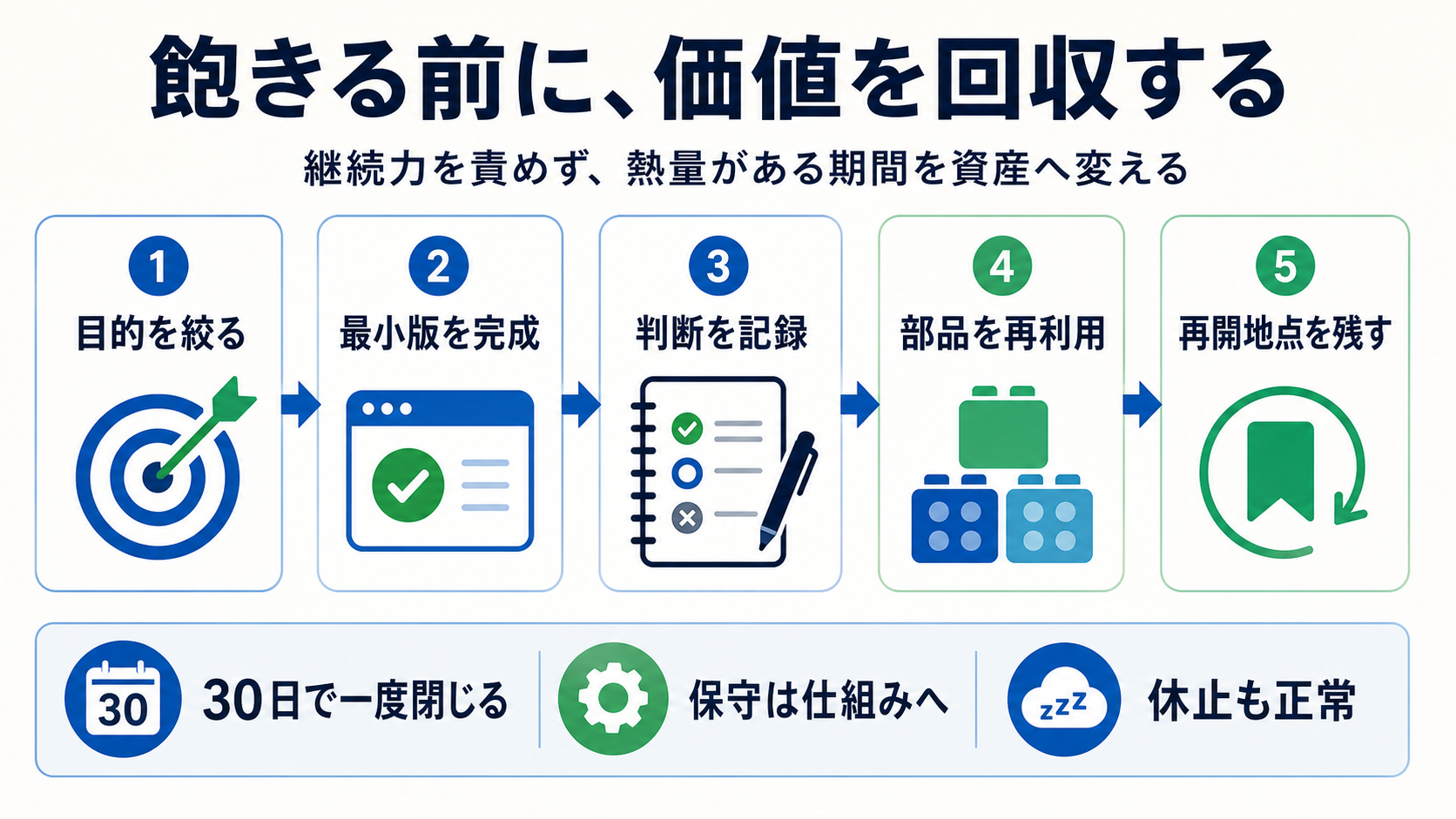
Section 01 — A short burst of focus can create significant value
A short burst of focus can create significant value
People who get bored easily can be highly focused while their interest lasts.
They may learn a new tool, build a prototype, and connect knowledge from other fields within weeks. Unlike people who move at a steady pace over a long period, they can accelerate dramatically at the start.
If you ignore that acceleration and force yourself into the same small daily routine, you may lose the strength as well.
Instead, design for periods of high energy and turn them into value you can keep.
Section 02 — “Finish it someday” is too late
“Finish it someday” is too late
For someone who gets bored easily, a plan to finish six months from now is risky.
Half-built projects, material you only read, and decisions that exist only in your head all stall when interest fades—and are hard to resume.
So make the unit of completion smaller.
Even if it is not the final version, make it publishable within 30 days. For a tool, get one feature working. For writing, finish one article. For research, put the conclusion and supporting evidence on one page.
Instead of aiming to finish something big someday, repeatedly close a small unit in a short time.
Section 03 — Divide projects into three types
Divide projects into three types
If every interest gets equal weight, the number of unfinished projects keeps growing.
Instead, divide projects into three types:
Core: something to build over the long term
Sprint: create one deliverable in a few weeks
Exploration: something to try without requiring a deliverable
Treating exploration like a core project creates a burden. Treating a core project like exploration leaves it directionless. Defining each project's role at the start makes it easier to decide what to do when you get bored.
Section 04 — Capture four things before your interest fades
Capture four things before your interest fades
There are four things to capture while your interest is strong.
First, a deliverable. Make something others can understand, such as an article, code, template, or research table.
Second, decision criteria. Record what you considered good and what you rejected.
Third, reusable components. Separate prompts, designs, tests, data structures, and anything else that can move to the next project.
Fourth, a restart point. Write down what to do next, unresolved problems, and where the necessary files are.
With these four things, the experience remains even if your interest fades midway.
The problem is not getting bored.
The value you gained before your interest faded is not preserved.
Section 05 — Schedule a review date up front
Schedule a review date up front
It is hard to predict when you will get bored. So schedule a review while your enthusiasm is still there.
At the end of each week or on day 30, review what you have achieved, what to keep or stop, and what to use elsewhere. It is too late to organize everything after the project is finished.
A review is not a session for self-criticism. It turns your energy into assets.
Section 06 — Hand maintenance to AI and systems
Hand maintenance to AI and systems
You may enjoy creating something but struggle to keep maintaining it.
Automate updates, turn review items into a checklist, and delegate routine work to AI. Set things up so basic operations continue even when your interest shifts elsewhere.
You do not need to automate everything. Maintenance becomes easier if you at least know where to look for problems.
Section 07 — Do not treat a pause as failure
Do not treat a pause as failure
If you treat a paused project as a failure, unfinished work becomes a psychological burden.
But if you captured the deliverable, criteria, components, and restart point, a pause is a normal state. You can resume when it becomes useful or reuse the material in another project.
Not continuing does not mean the work was wasted.
Section 08 — Design for restarting, not just persistence
Design for restarting, not just persistence
Continuing for a long time is not the only right answer.
Dive deep for a short time, capture the value, and move on. Designed around this pattern, boredom can become speed in exploration and production.
The goal is not to become someone who works on a project every day. It is to design a project that leaves something behind when paused and can be resumed when needed.
Section 09 — A 30-day sprint to capture value
A 30-day sprint to capture value
You cannot predict exactly when interest will fade. Instead, plan to close one cycle within 30 days from the start.
| Period | Activity | What to keep |
|---|---|---|
| Days 1–3 | Define the core interest and completion criteria | One-sentence goal and what is out of scope |
| Days 4–10 | Build the minimum version | Working prototype, one article, or research result |
| Days 11–17 | Use it and fix problems | List of failures and decision criteria |
| Days 18–23 | Separate reusable components | Templates, prompts, and data structures |
| Days 24–27 | Prepare it for another person or your future self | README, instructions, and references |
| Days 28–30 | Decide whether to continue, maintain, or pause | Status, next step, and conditions for resuming |
It is important to define what not to do during the first three days. When your interest is strong, related features and other topics can look appealing. The broader the scope, the more likely your energy will fade before completion. You do not need to finish an entire business in 30 days. Aim to release one valuable unit by the end of the month.
Section 10 — A template for capturing project assets
A template for capturing project assets
Before pausing a project, put the following on one page:
Project name
Use a specific name that shows what you set out to build.
What you completed
List facts only: completed features, articles, research, data, public URLs, and so on.
What you learned
Record what worked, what failed, and what differed from your expectations.
What can be reused
List code, designs, prompts, checklists, and decision criteria.
Open issues
Separate technical problems, policy checks, missing data, and business viability.
Conditions for resuming
Write a concrete trigger for resuming, such as “once API terms allow it” or “when monthly search impressions exceed a target,” instead of “when I have time.”
What to do in the next 30 minutes
Write one small next task so you do not have to rethink everything when you resume.
This one-page record makes it much easier to resume months later. You cannot preserve your enthusiasm, but you can preserve context and a restart point.
Section 11 — Criteria for continuing, delegating, or pausing
Criteria for continuing, delegating, or pausing
On day 30, choose one of three options:
Continue
- You have confirmed users, readers, or meaningful results
- The next improvement is clear
- You still have a question you want to test
- The maintenance cost is acceptable
Delegate maintenance
- The core is complete
- Updates can be standardized
- You can hand off the process to AI, automation, or another person
- It can run without your decision every time
Pause
- Demand or user value is unconfirmed
- Progress depends on external conditions
- The same learning can come from another project
- The only reason to continue is “I have already come this far”
Pausing is not a failure if you have captured the deliverable and decisions. Continuing to maintain something by inertia after your interest has disappeared may consume the energy for your next burst of focus.
How much value should you capture from a web service?
Suppose you spend a month absorbed in a small price-comparison service and then your interest moves elsewhere. If you focus only on the fact that you can no longer add features every week, it may look like a failure to continue. But if you leave the following behind, you have captured substantial value:
- A minimum version is public, and others can view the main screens.
- Product data is retrieved and updated automatically at a defined frequency.
- There is an error state and recovery process for an unavailable external API.
- You can later check which search terms, pages, and features were used.
- Research on terms, competitors, and product-matching rules is documented.
- Another person—or your future self—can understand the state in 30 minutes.
On the other hand, a polished interface is not enough if it runs only on your PC, nobody knows where the API key is, updates require daily manual work, and the reasons behind the design are undocumented. Instead of adding features before you get bored, invest time in what will remain even if you leave today.
For research, create more than an article
Getting bored with research does not make it worthless if you did not finish an article. Organize the primary sources, comparison tables, decision criteria, open questions, and unusable information so you can reuse them in another article or business decision. In particular, recording why you rejected an idea can prevent you from returning to the same one months later. Value from a short burst of focus grows when you allow different deliverables. Separate public work, internal material, reusable components, and failure logs, and even an unfinished project can support the next one. People who get bored easily do not need to carry every project to the end. They need a portfolio approach: explore while energy is high, close a unit of value, and keep only what can be maintained.
Decide how the sprint will end at the start
When your energy is high, it is easy to focus only on adding features or articles. On day one, write one sentence describing what would count as a milestone after 30 days. Set a minimum publishable version, a question to test, components to preserve, and an upper limit on time. A defined endpoint helps you focus on the important work before your interest fades. Set a time limit too. Working late every night may speed things up temporarily but disrupt your life until you suddenly cannot work on it anymore. Plan for intense focus while protecting sleep, work, and meals. The aim is to turn your energy into a result before it burns out, not to sustain it indefinitely.
Do not switch as soon as a new interest appears
If another idea looks appealing, save it in an exploration note instead of abandoning your current project and starting immediately. Write its name, why it interests you, and what you would research first; wait until the current sprint ends. If you are still interested, try it during the next exploration period. This pause does not suppress ideas. Switching contexts every time one occurs makes it easy to stop each project right before release, documentation, or handoff. Close the current unit of work before moving on, and you can begin the new idea without guilt.
Do not trust your past self too much when resuming
When you return months later, assumptions and external conditions may have changed. Do not act immediately from the saved restart point; briefly recheck terms, APIs, competitors, and the data in use. Past decisions are a starting point, not necessarily still correct. During the first 30 minutes back, run the deliverable, read the open-issues list, and do one next task. Even if you want to redesign everything, first check the current state. Reconnecting in small steps makes it easier to focus again, even after a long pause.