Even in your 40s,
growth does not have to slow down.
Use AI to shift from quantity to quality
People often imagine that after 40, learning slows down and work narrows to familiar strengths. Over the past year, I experienced the opposite. I quickly expanded what I could do with Git, AI agents, web development, data processing, Chrome extensions, and site operations. I became faster at solving problems at work and in personal projects. I did not get younger; the number of experiments changed.
Fewer new challenges mean fewer encounters with unfamiliar problems
One reason growth can stall with age is that people take on fewer new challenges. Work methods become fixed, people choose safer options, and keep using the same tools. Experience grows, but exposure to unfamiliar problems declines. AI lowers the time and cost of experimentation: you can research, build a prototype, fail, and revise in a short cycle.
One efficiency improvement creates room for the next experiment
For a task combining statements and sales data, I had AI reverse-engineer the calculation logic and built a process to verify consistency. A job that took hours now takes about ten minutes. The value is not just the one-time time savings: the same structure can be applied to other financial data, the verification process can be reused, and the time saved can go toward another improvement.
Do not separate learning from practical improvement
If all the time saved goes to other routine tasks, it is unlikely to support growth. Use some of it for another automation, tool, or foundational learning. That can shorten another task and create more time. Learning and work improvement become one cycle: real work is the learning material, and what you build goes back into the job.
Solving small problems repeatedly reveals common patterns
Repeatedly solving small problems can teach more fundamentals than building one large system. Export reviews to CSV, download PDFs from a page in batches, save images together, or transform routine data. Each task may be small, but common structures emerge: input, processing, output, exceptions, and verification. Then you can see how to combine them to solve another problem.
Understand what to connect instead of memorizing syntax
AI writing code does not make all knowledge unnecessary. A basic model of how browsers use HTML, CSS, and JavaScript, how buttons trigger events, and how APIs pass data lets you judge what is possible without knowing every implementation detail. Instead of memorizing syntax, understand what needs to connect and let AI fill in the steps between.
Failures and revisions develop practical judgment
As you run more experiments with AI, you get faster at judging its output. You learn which requests are ambiguous, where data inconsistencies arise, what to question in a completion report, and what to automate or review yourself. Repeated failures and revisions develop judgment that is hard to gain from reading alone.
Deliverables are evidence of growth
Growth is difficult to notice day to day. Keep a record of tools you built, time saved, technologies you tried for the first time, failed approaches, and reusable components. Review the list six months later and you can see how much more you can handle. Deliverables are not only useful in future work; they are evidence of your growth.
Combine experience with AI to solve a broader range of problems
Physical changes come with age, but work ability does not necessarily decline at the same rate. Use AI to lower the cost of repetition, increase experiments, and accumulate decision criteria; you may be able to solve a broader range of problems than before. Do not stop learning because of your age—combine experience with AI precisely because you have it.
Growth is shaped not only by age but by
The distance from experiment to result.
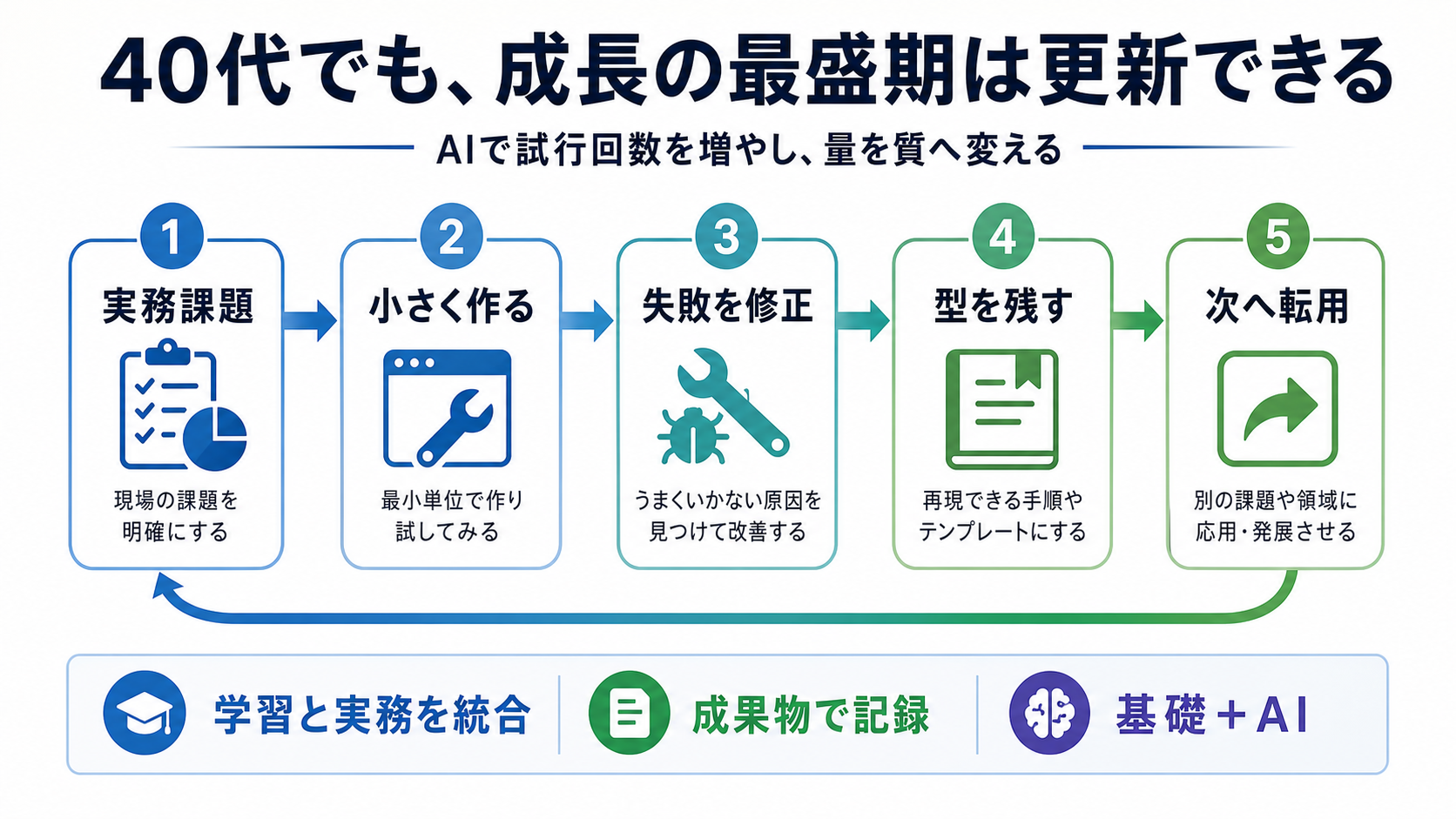
Repeat building, testing, understanding, and preserving throughout the day
What changed when I started using AI was less the speed of gathering knowledge than the number of experiments I could run and observe. Previously, I would study a technology through books, courses, and exercises before applying it at work. Now I break the task in front of me into smaller problems, research what I need, build something that works, and fix what fails. This cycle can repeat several times a day.
In this cycle, learning and work are not separate. If a task drops from several hours to ten minutes, you can use that time for another improvement. That improvement may free up more time for a harder problem.
But simply counting things that AI built after an unbounded handoff will not turn quantity into quality. You still need to understand the input, the impact of failure, and how to judge a correct result. People with practical experience bring a lot of this evaluation context. The work knowledge accumulated by your 40s is not baggage in the AI era; it is a criterion for selecting AI output.
Complete one improvement cycle each week
Even without setting aside separate study time, you can complete one improvement cycle each week.
| Day | Activity | Deliverable |
|---|---|---|
| Monday | Choose one recurring task and measure its current duration | Problem note and baseline time |
| Tuesday | Define inputs, outputs, exceptions, and prohibitions | A small specification |
| Wednesday | Build a minimum version with AI and test it with sample data | Prototype |
| Thursday | Verify it with real work data and fix failures | Verification results |
| Friday | Record the process, decisions, and time saved | Reusable template |
| Month end | Review the four weeks and apply what worked elsewhere | Results and the next problem |
Not everything needs to become a program. It could be a writing template, spreadsheet formula, browser extension, checklist, or AI prompt. What matters is being able to compare time and quality before and after.
Instead of jumping to a new technology every week, make the same kind of task gradually harder. Start by organizing filenames, then extract content, detect exceptions, and finally schedule the process. A series of small successes and failures develops judgment about what to give AI and what people should review.
Record each month what you have learned to change
Age-related concerns can grow when judged only by how you feel. Even if you think, “I do not remember as much” or “There are too many new terms,” a record of what you have learned to do gives you another measure of growth. Keep more than certificates and study hours:
- Task duration before and after an improvement.
- Small tools or extensions you built.
- Examples of catching AI mistakes.
- Checks added after something broke.
- Templates reused in other work.
- Ideas you rejected and why.
- Systems still in use a month later.
Collect these on one page each month and you can see not just what you studied but what you learned to change. This record can guide your next step, not only a job search or performance review.
As you become able to produce more, do not turn all of it into formal work. If AI lets you handle four people's output but you also take on four times the responsibility, growth becomes exhaustion. Use some of your new ability not to add work but to leave at six, make time to think, or stop unnecessary tasks.
Make time to return to fundamentals, especially with AI
When a prototype works quickly, it is easy to move on while important details remain unclear. Instead of relearning everything each time, understand the boundaries that could cause an incident. For a file-deletion task, know the scope and recovery method; for an external API, know its terms and failure state; for a public article, be able to explain fact checks and the scope of quotations.
Asking AI to explain code may not be enough. Change the inputs, deliberately test failures, and compare another implementation to see whether the explanation matches behavior. If you cannot judge correctness yourself, limit what reaches production and ask an experienced person to review it. Do not confuse fast creation with safe delegation.
In your 40s, it may be more productive to choose technologies that affect your work than to follow every new trend. In e-commerce operations, that might mean data organization, browser automation, APIs, writing, or review. Choose based on whether it can reduce this week's work or improve decision accuracy, not because it is popular.
Do not let increased ability create unlimited work
When you notice your growth, you may want to take on everything you can do. But if more work is assigned to the person who has increased their output with AI, there is no room left to learn. Track time, quality, and scope before and after efficiency improvements, and reserve some of the time saved for learning and improvement. If all of it becomes extra work, the shift from quantity to quality stops.
Busyness is not evidence of growth. You may be able to make a small improvement that once required outside help, isolate a cause of failure, ask AI to support an answer, or stop unnecessary work. Recording these changes in judgment shows that more than your work speed has improved.
There is no need to limit your potential because of age, but you do not need to copy how younger people learn either. Start with accumulated work knowledge, increase experimentation with AI, and keep only reusable patterns. Connecting experience with new tools can support growth at this stage of life.