A marketer’s track record can be
AI Process Improvement PMtranslated into AI operations and project management.
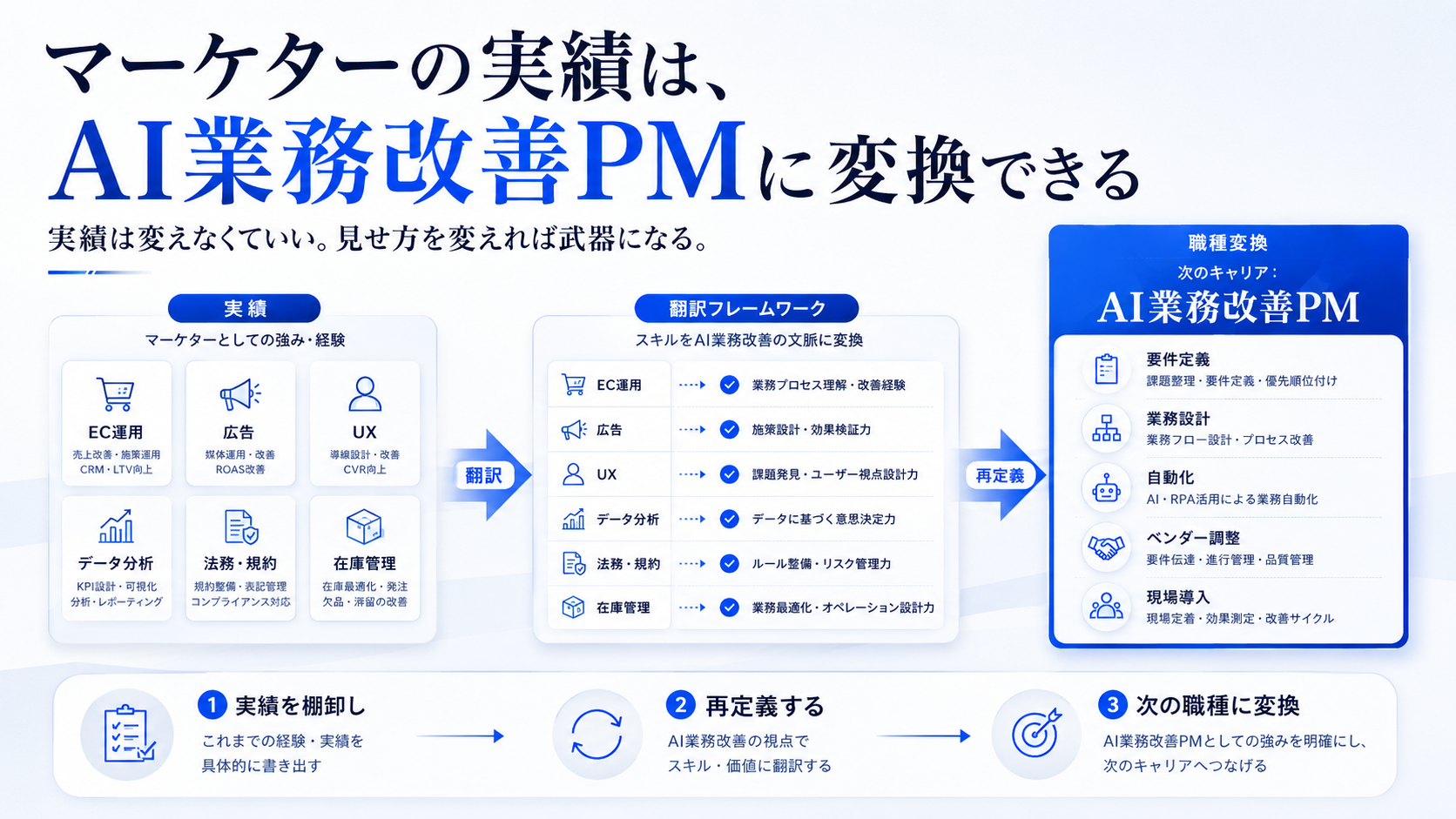
Feeling bored with marketing does not mean that your experience has gone to waste. The data organization, process design, e-commerce operations, legal review, and AI use you have done in marketing can translate into other roles. The key is not to sell yourself only as “a marketer,” but to show how you break down complex work, create decision criteria, and make processes reusable with AI and tools.
Marketing Work Is More Cross-Functional Than It Looks
The title “marketer” may suggest someone who manages advertising, social media, promotions, or CRM. In practice, the job often goes beyond that.
You organize product information, coordinate legal and compliance reviews, structure landing pages, build e-commerce journeys, aggregate metrics, investigate anomalies, and improve workflows.
Many of these responsibilities connect directly to AI process improvement and digital transformation. That is because the real bottlenecks in AI adoption are often breaking down work, organizing data, and making decision criteria explicit—not choosing a model.
The perspective changes when we look beyond job titles to what someone has actually structured. Marketing experience can be framed not as a history of campaigns, but as evidence of moving complex work forward.
Translate Outcomes into Repeatable Improvement Methods
A strong job application is about more than saying, “I increased sales.” Explain the problem you found, how you broke it down, what decision criteria you established, and what system you built. That sequence makes the result repeatable.
Launching on Amazon, building a Shopify store, processing CSV files, creating inventory alerts, and automating checks with AI can be described not as one-off tasks, but as experience designing systems that move work forward.
“I entered product listings” is a weak description. But “I organized product information rules, standardized review criteria, and set up a way to detect missed updates” describes a process improvement.
An AI process improvement PM needs more than the ability to create impressive AI demos. They must turn ambiguous frontline work into procedures, data, and decision criteria that anyone can follow. Marketing work often develops exactly this cross-functional ability.
Show the Decision Infrastructure You Built with AI, Not Just Time Saved
When people discuss AI use, they often focus on hours saved. That is an easy result to understand, but greater value may come from putting decision criteria and knowledge into a form AI can use.
Compliance review criteria, review analysis, work procedures, anomaly detection, daily reports, and an insight database all turn work that once depended on personal intuition into reusable systems.
Simply having used AI may not strengthen a résumé. What matters is what information you gave it, what you asked it to assess, where people reviewed the result, and how you incorporated it into operations.
When you can explain that, you look less like someone who merely tried AI and more like someone who connected AI to business operations. That is where the experience can translate into an AI process improvement PM role.
Present the Same Experience Differently for Different Roles
For a process improvement role, emphasize procedures, standardization, and reducing dependence on individuals. For an AI adoption role, emphasize reference data, operating rules, and risk management more than prompts.
For e-commerce operations, highlight product data, inventory, advertising, reviews, and sales records. For a project manager role, emphasize stakeholder coordination, requirements definition, risk management, and scheduling.
The same achievement can sound very different with a different label. This is not about dressing up the wording; it is about accurately translating the work into terms that align with the other person’s evaluation criteria.
Marketing experience can look narrow when it is limited to advertising and promotions. Framed as problem discovery, customer understanding, data organization, stakeholder coordination, and continuous improvement, it can look much closer to AI process improvement or digital transformation work.
The job title does not need to change;
How to Present Your Experiencethe way your achievements are framed does.
Marketing Experience Can Be Reframed in the Language of AI Process Improvement
Rather than listing tasks as they are, it is stronger to translate them into language that works across roles. Breaking down the actual work can connect much of a marketer’s experience to process improvement, data operations, project management, and AI operating design.
- Managed advertising and promotions
- Operated an e-commerce site
- Compiled data in Excel
- Used AI to reduce working time
- Handled compliance reviews
- Built the data foundation needed for campaign decisions
- Led e-commerce setup through operating design
- Made aggregation and reconciliation processes reusable
- Advanced process standardization using AI
- Made decision criteria explicit and reduced risk
In Practice, This Sequence Makes the Idea Easier to Apply
Here is a sequence for turning the idea into points you can use in a résumé or interview.
How to Identify Experience That Transfers to a New Role
Break down marketing experience into elements valued in other roles, rather than presenting it as is. The strongest evidence may be not sales itself, but the systems you built to make sales or improvements repeatable.
Strong Transferable Evidence
- I have launched something from zero to one
- I have established decision criteria
- I have shortened work with AI or tools
- I have managed legal or compliance aspects
- I have coordinated multiple stakeholders
Ways of Presenting Experience That Can Weaken It
- List only areas of responsibility
- Present sales figures without context
- Stop at saying that I used AI
- Focus mainly on how difficult it was
- Fail to translate it into the target role’s language