KPI Design, Signal Detection, and Progress Tracking: Core PM Work
Creating KPIs, reviewing metrics, and checking progress are more than reporting tasks.
They involve defining success, detecting deviations, and deciding what to check next.
This is core project-management work, not just marketing work.
Projects need metrics to keep moving.
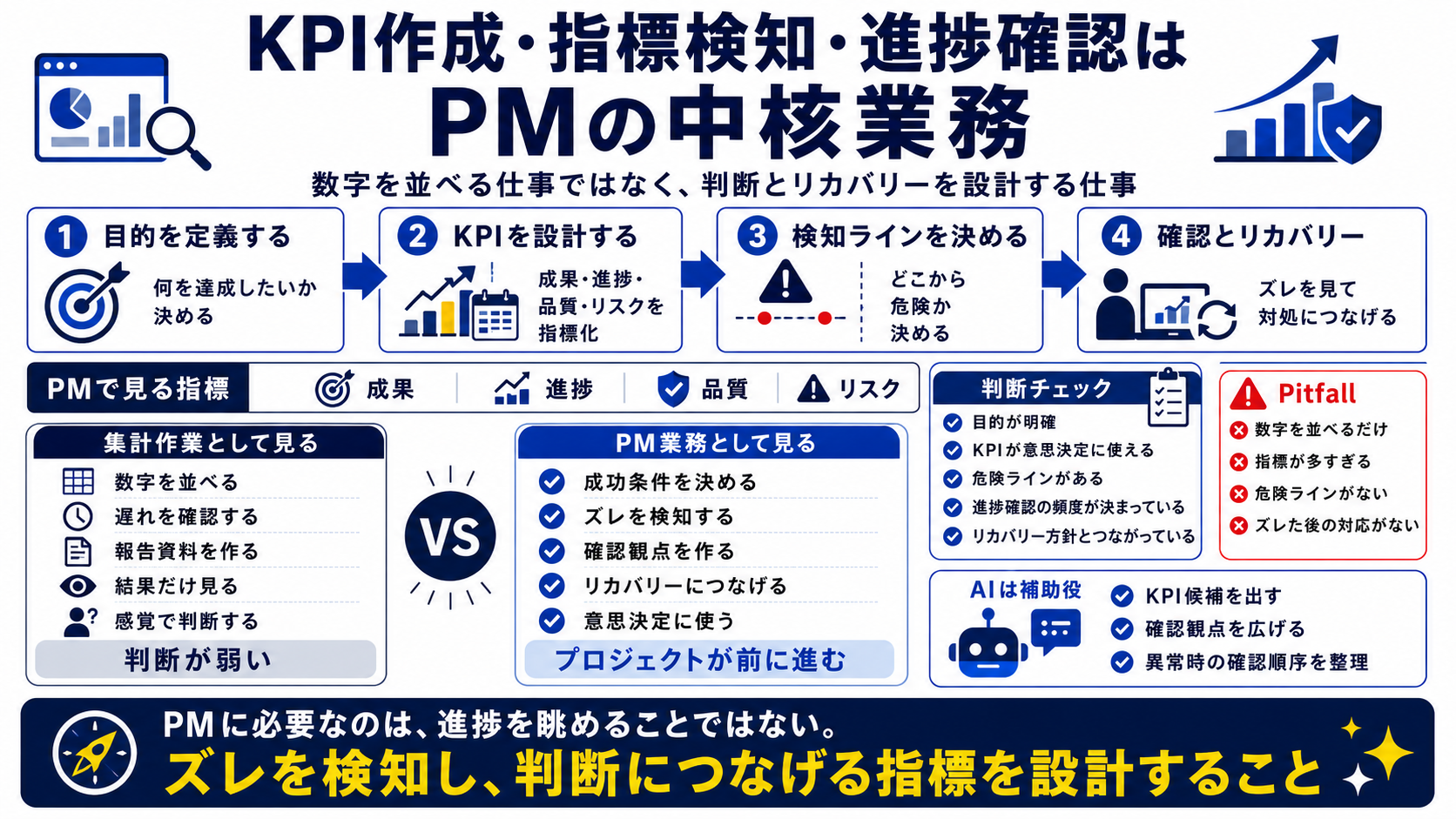
KPIs are for making decisions, not just reviewing results
KPIs are not just numbers to display.
They help determine what counts as on track, when a situation becomes risky, and what needs to improve.
KPI design is therefore decision design.
For a project manager, creating metrics makes a project visible. It turns goals, deadlines, quality, risks, and stakeholder expectations into things that can be checked.
A good KPI is not a number that makes a meeting deck look polished. It is a signal for deciding what to check next, where to allocate resources, and which decisions to hold.
Progress reviews are for finding deviations early, not blaming people for delays
Progress reviews are often seen as a way to challenge people who are behind.
Their real purpose is to find deviations from the plan early and respond before it is too late.
Regularly checking metrics, deadlines, deliverables, risks, and stakeholder expectations helps surface problems early.
This is an important project-manager responsibility. In a project with weak progress reviews, there may be few options left by the time a delay becomes visible. Detecting deviations early leaves room to adjust scope, change priorities, or involve more people.
Metric monitoring is anomaly detection for a project
Sales fall, progress slows, CVR declines, inventory drops, or inquiries rise.
To detect such changes, decide in advance which metrics to monitor.
Without metrics, problems are visible only as a feeling.
KPI design and signal detection act as an anomaly-detection system for a project. Decide in advance what is normal, what calls for attention, and when action is required, so every meeting does not rely on gut feeling.
A project manager does not need to inspect every number in detail. The job is to choose the metrics to watch and decide what to investigate when they change.
AI can support KPI design and review criteria
AI can suggest KPI candidates based on a project’s goals and organize what to check when an anomaly occurs.
But AI cannot fully determine business priorities.
The project manager provides goals and constraints; AI helps broaden the set of perspectives.
This division of work can improve KPI design and progress reviews. AI can suggest metrics, review sequences, risks, and meeting agendas. The project manager still decides what matters, which risks are acceptable, and who needs to be consulted.
KPI design, signal detection, and progress tracking are
core project-management responsibilities.
The same numbers can lead to different actions depending on how they are viewed
Whether you treat KPIs as reporting or as decision tools changes what you build and what you discuss in meetings.
- List the numbers
- Check for delays
- Prepare a report
- Look only at outcomes
- Rely on intuition
- Repeat the same checks after every meeting
- Define success criteria
- Detect deviations
- Set review criteria
- Connect to recovery actions
- Use the metrics to decide
- Clarify who to consult next
A practical order for applying this idea
Turn the idea into steps for project management, operational improvement, and tool-building.
A checklist for project managers reviewing KPIs
Set review criteria in advance so the numbers lead to action.
Potential areas for improvement
- The objective is clear
- KPIs can inform decisions
- Risk thresholds are defined
- Progress-review frequency is set
- There is someone to consult when metrics shift
- Metrics connect to a recovery plan
Failure patterns to avoid
- Only displaying numbers
- Using too many metrics
- Having no risk thresholds
- Leaving the response to a deviation undefined
- Stopping at the reporting deck
- Depending on an individual’s intuition