Treat Criticism as Data About Differences in Judgment Standards
Feedback or reprimands at work naturally stir up emotions.
Sometimes they feel unfair; at other times, it is hard to understand why the issue is being raised now.
But if criticism ends as simply an unpleasant experience, little reusable learning remains.
Feedback and reprimands can be treated as data about differences from another person’s standards.
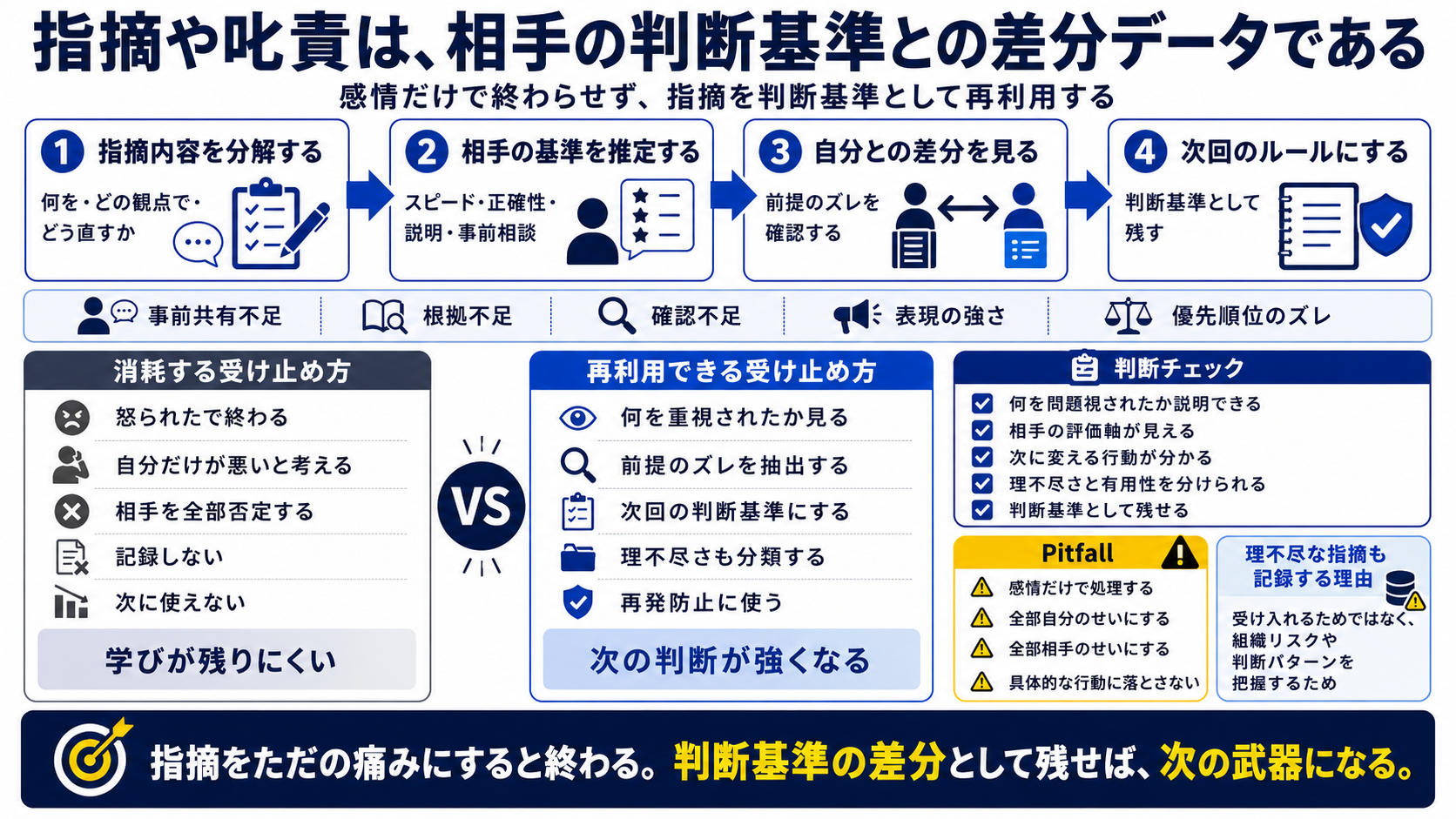
Feedback Shows What the Other Person Values
Feedback reveals the other person’s values and standards for making decisions.
Do they value speed, accuracy, accountability, or consultation in advance?
The same action can be judged differently depending on the other person’s standards.
So feedback can tell me not only whether I was wrong, but also what criteria the other person uses to evaluate the work.
Separate Emotion from Data
Right after a reprimand, emotions come first.
Once I have calmed down, I can look at what was seen as a problem, which assumption was misaligned, and what I should change next time.
I do not need to ignore my feelings, but if the experience ends there, I will not retain a useful lesson.
If I can extract the underlying standards from the event, I can more easily avoid repeating the same mistake.
Record the Difference to Inform Future Decisions
Turning feedback into data does not mean saving the other person’s words verbatim.
It means organizing what behavior was addressed, from what point of view, and what was expected.
For example, I can classify it as insufficient advance communication, weak evidence, missed checks, overly strong wording, or a mismatch in priorities.
As these categories accumulate, they become a database of the other person’s or organization’s decision standards.
Handle Unreasonable Feedback Differently
Not all feedback is correct.
Some feedback may be unreasonable, emotional, raised only after the fact, or close to shifting blame.
Even so, it can be useful to record the circumstances in which this kind of feedback occurred.
It is important to distinguish feedback I should accept from feedback I should treat as an organizational risk.
Feedback and reprimands are
Data on Differences from the Other Person’s Standardsdata that reveals differences in standards.
A Different Perspective on the Same Topic Changes What We Do
This is not just about efficiency; it changes how we view work itself. Separating what people should handle from what can be built into a system makes practical decisions easier.
- Treat it as nothing more than getting told off
- Assume I am entirely at fault
- Completely dismiss the other person
- Keep no record
- Have nothing to apply next time
- Identify what the other person valued
- Identify the misaligned assumptions
- Use it as a standard for future decisions
- Classify unreasonable feedback too
- Use it to prevent recurrence
In Practice, This Sequence Makes the Idea Easier to Use
Here is a process for turning the idea into practical improvements, tools, or articles instead of leaving it as an abstract concept.
A Checklist for Applying the Idea at Work
Turn the idea into points I can check in practice, so it does not end with reading the article.
Signs That May Point to an Improvement
- I can explain what was seen as a problem
- I can identify the other person’s evaluation criteria
- I know what action to change next time
- I can distinguish unreasonable feedback from useful feedback
- I can record it as a decision standard
Failure Patterns to Avoid
- Respond only from emotion
- Blame myself for everything
- Blame the other person for everything
- Fail to turn it into a concrete action