The Employee’s Role Is to Reduce Work, Not Accumulate It
In organizations, people who diligently complete tasks are often rewarded.
But when repetitive tasks remain unchanged, the costs of requests, reviews, management, training, and handoffs keep growing.
The role of a full-time employee is not to keep taking on tasks, but to build systems that reduce them.
This role becomes even more important in the age of AI.
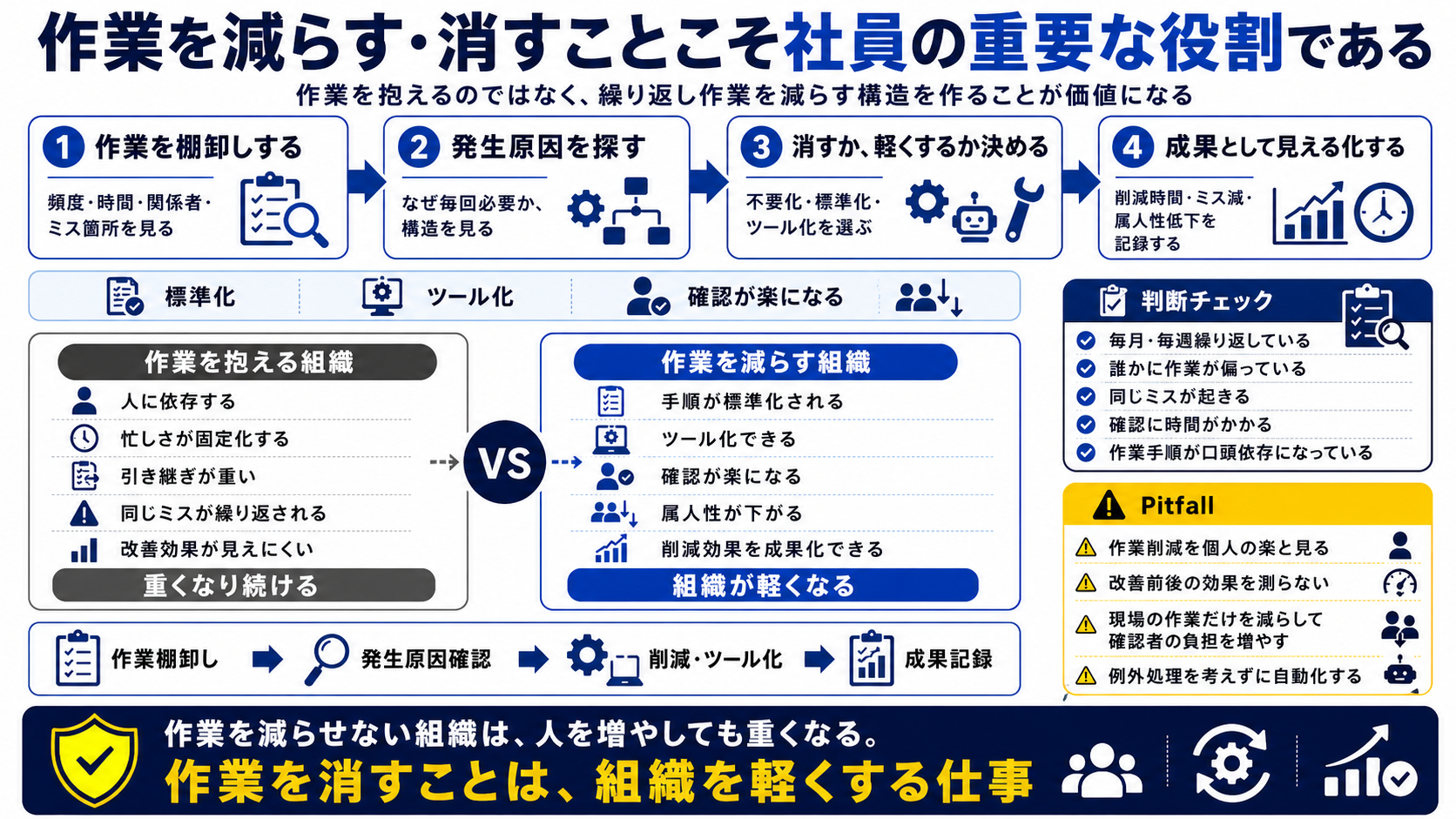
Processing Work Alone Does Not Change an Organization’s Cost Structure
The same report is compiled every month. The same checks are performed every time. The same information is copied in the same format. The same errors are corrected.
If people keep handling these tasks manually, work may seem to be getting done. But the structure of the work has not changed at all.
Instead, the organization becomes dependent on the people who can handle the tasks, busyness becomes entrenched, and handoffs grow harder.
An organization becomes truly stronger not when a particular person works hard enough to process everything, but when anyone can do the work without hesitation—or when the work no longer needs to happen.
Employees Should Examine the Structure That Generates Work, Not Just Its Volume
When there is too much work, simply adding staff or pushing people to process more will eventually reach a limit.
Why does the task arise? Is the input format poor? Are the review criteria unclear? Is the approval path too long? Is information scattered?
Looking at what generates the work makes it possible to see where it can be reduced.
AI and lightweight tools can help change the structure that produces the work.
Reducing Work Means Reducing Organizational Friction, Not Taking It Easy
Reducing work can sometimes sound like an excuse to take it easy.
In practice, it is organizational improvement that reduces errors, dependence on specific individuals, review time, and the burden on everyone involved.
Especially in the AI era, it can create more value to redesign work so AI and tools can handle simple tasks, rather than having people carry them all.
People should spend their time on judgment, improvement, and coordination—not get buried in routine work.
Record Reduced Work as an Outcome
From the outside, someone who reduces work may look less busy.
That is why the value can be hard to see unless the impact is recorded.
How many minutes did it take before the improvement, and how many afterward? How often does it happen each month? Can anyone use the new process? Have errors decreased?
Recording these details makes it possible to explain work reduction as a clear outcome.
An employee’s key role is
The goal is not to take on work, but to eliminate it.to build a structure that reduces work.
A Different Perspective on the Same Topic Changes What We Do
The important question is not simply whether to use AI. It is how to distinguish which tasks should remain, which should be reduced, and which decisions people should own.
- Depends on specific people
- Makes busyness permanent
- Makes handoffs difficult
- Repeats the same errors
- Makes improvement hard to see
- Standardizes procedures
- Turns work into tools
- Makes review easier
- Reduces dependence on individuals
- Turns work reduction into measurable outcomes
In Practice, This Sequence Makes the Idea Easier to Apply
Here is a process for applying the idea to real work improvements instead of leaving it as a concept.
A Checklist for Applying the Idea at Work
Turn the idea into points that are easy to check in practice, so it does not end with reading the article.
Signs That May Point to an Improvement
- It recurs every month or week
- The work falls disproportionately on one person
- The same errors keep happening
- Reviews take a long time
- The procedure depends on verbal instructions
Failure Patterns to Avoid
- Treat work reduction as personal convenience
- Fail to measure the effect before and after improvement
- Reduce frontline work but increase the reviewer’s burden
- Automate without accounting for exceptions