The Real Skill Behind Reading Numbers
When working with numbers, I sometimes wonder whether I am actually good with them.
But that does not necessarily mean I enjoy calculations or have a natural talent for numbers.
In practice, the real strength is less about the numbers themselves and more about the ability to read numerical gaps as structure.
It is the ability to see where things align and where they begin to diverge.
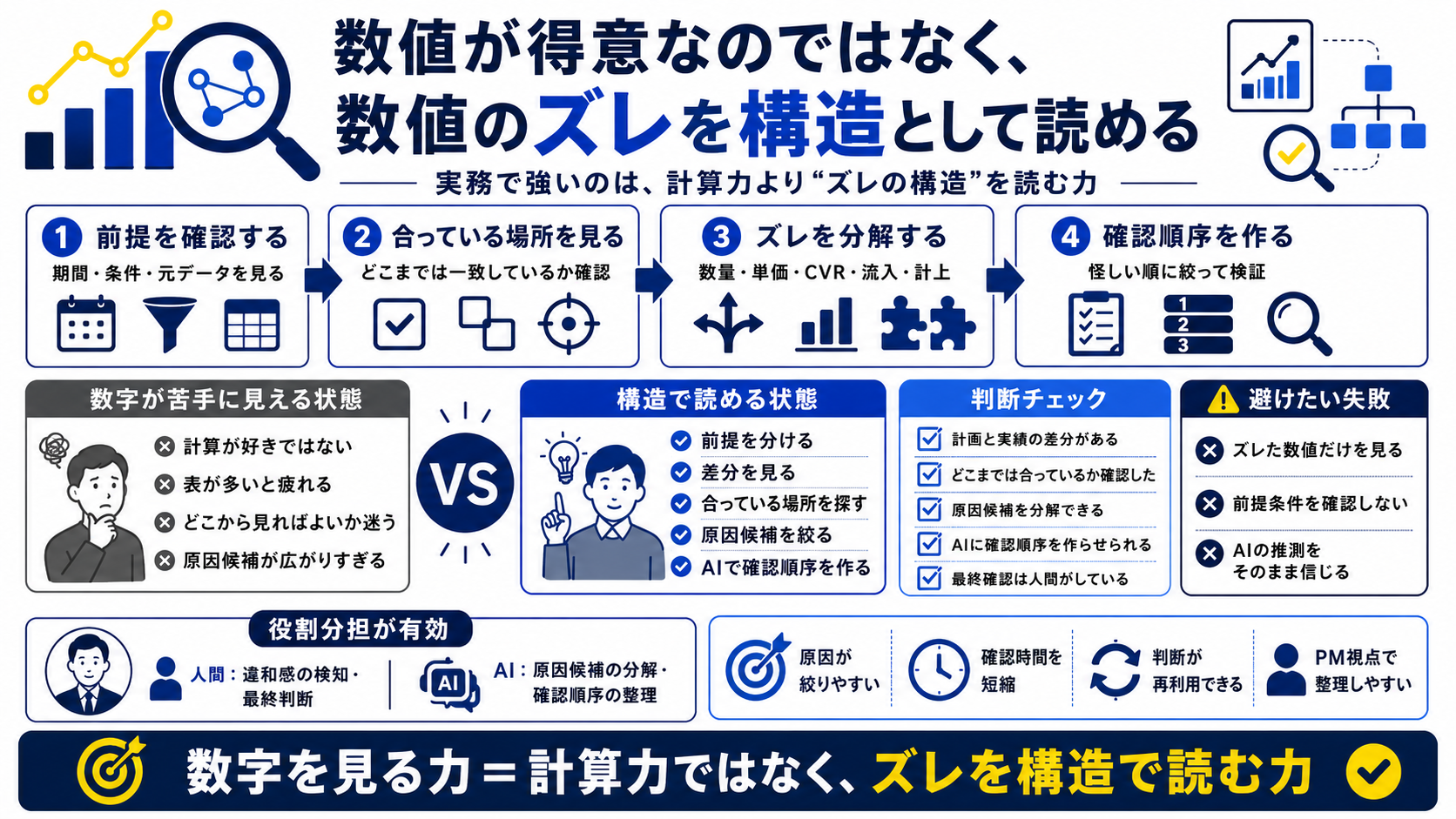
Numerical Skill Is More Than Calculation
In practical work with numbers, it is more important to understand assumptions, structure, comparisons, and differences than to perform complex calculations.
Sales, ad spend, conversions, inventory, budgets, actuals, year-over-year comparisons, and variance from plan.
These figures have little meaning on their own.
Their meaning becomes clear when we see how they relate to other metrics and where the gaps appear.
A Gap Is a Clue to Possible Causes
When the numbers differ from plan, it is not enough to simply call them bad.
Which metric diverged? Was it quantity, unit price, conversion rate, traffic, inventory, or the timing of recognition?
Breaking down the gap reveals possible causes.
This breakdown resembles the process of debugging.
Start with What Matches to Narrow Down the Cause
When investigating inconsistent numbers, looking only at the places that do not match can be confusing.
Instead, checking what still matches makes it easier to narrow down the cause.
Do the numbers match up to data retrieval? Did the difference arise from aggregation criteria, manual entry, or display formatting?
Checking where things match helps reveal where the problem lies.
AI Can Help Break Down Possible Causes
AI tools such as ChatGPT cannot magically identify the right numbers.
But if I provide suspicious figures, AI can organize possible causes and a review sequence.
This can significantly reduce the time spent checking numbers.
A useful division of labor is for a person to spot something unusual, AI to help break it down, and a person to perform the final review.
It is not about being good with numbers.
Read numerical gaps as structureIt is about reading numerical gaps as structure.
A Different Perspective on the Same Topic Changes What We Do
This is not just about efficiency; it changes how we view work itself. Separating what people should handle from what can be built into a system makes practical decisions easier.
- I do not enjoy calculations
- Large spreadsheets are tiring
- Looking at numbers feels overwhelming
- There are too many possible causes
- I am not sure where to start
- Separate the assumptions
- Look at the differences
- Find what matches
- Narrow down possible causes
- Use AI to create a review sequence
In Practice, This Sequence Makes the Idea Easier to Use
Here is a process for turning the idea into practical improvements, tools, or articles instead of leaving it as an abstract concept.
A Checklist for Applying the Idea at Work
Turn the idea into points that are easy to check in practice, so it does not end with reading the article.
Signs That May Point to an Improvement
- There is a variance between plan and actuals
- I have checked what still matches
- I can break down possible causes
- I can ask AI to propose a review sequence
- A person performs the final review
Failure Patterns to Avoid
- Look only at the numbers that differ
- Skip checking assumptions
- Trust AI’s guesses without verification
- Expand the list of possible causes too quickly