Before You Trust an AI-Generated Business Idea,
Make It Research the Competition
Ask ChatGPT for a business idea in a market that is not saturated, and it will generate several appealing options.
Use information gaps between Japan and overseas. Organize public data and sell it. Build a database for a specific industry. Each sounds promising when you first read the pitch.
But a novel-sounding idea is not necessarily a viable business.
The moment you decide “this could work” without researching competitors, the proposal is a story—not a marketing strategy.
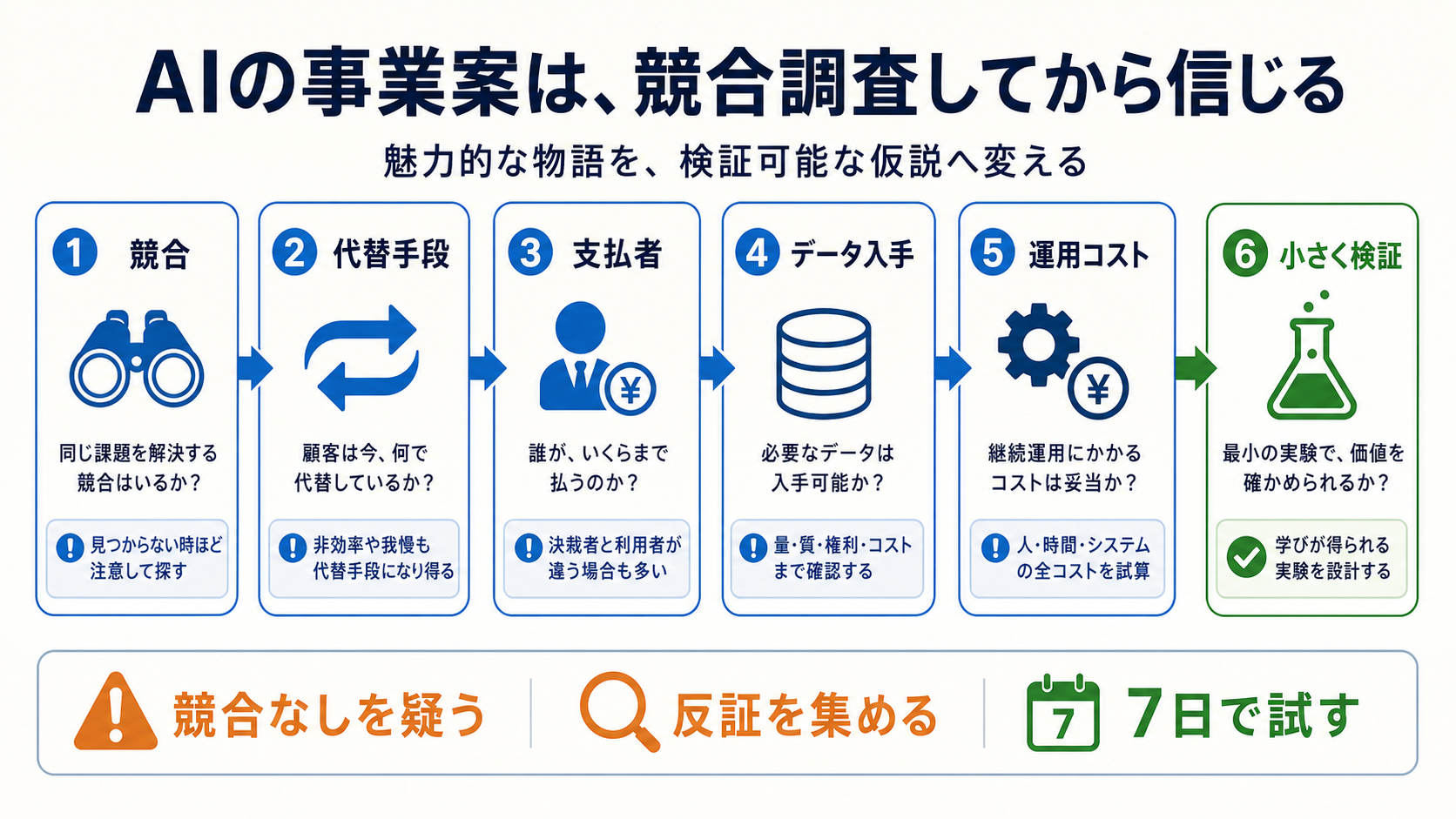
AI can generate plausible ideas endlessly
Generative AI is good at combining ideas to meet specified conditions.
Want to earn foreign currency, avoid interpersonal work and manual tasks, and take advantage of information gaps? Give it those conditions and AI can construct a plausible business model.
The problem is that AI may discuss how attractive an idea is and whether it is feasible in the same breath. A confident explanation can make it seem validated.
But generating an idea and verifying facts about the market are separate tasks.
“No one is doing this yet” is a dangerous claim
A market with no obvious competitors can look attractive.
But there are two reasons you may not find competitors: no one has noticed the opportunity yet, or people have tried and decided it is not viable.
There may be no demand, no way to get the data, terms that prohibit reuse, a need for direct sales, high update costs, or no paying customers.
Before treating an absence of competitors as an advantage, find out why they are absent.
Look beyond direct competitors
The absence of a service with the same features does not mean there is no competition.
People may use Excel, search, free public information, an existing industry database, or manual work by a colleague to solve the problem. These are all substitutes.
Do not only ask, “Is there an identical service?” Ask, “How do people solve this problem now?”
Unless your offering is faster, cheaper, more accurate, or easier than the alternatives, there is no reason to switch.
Identify who pays and what they pay for
A business idea needs someone who will pay.
The user and payer may differ. A frontline employee may use it, while a manager signs the contract. An individual may find it useful but will not pay if free information is enough.
Who has the problem? How much time or money do they lose now? Whose budget will pay after it is solved? If you cannot answer these three questions, the idea is not yet a business.
Can you access the necessary data continuously?
For a data business, continuously collecting data is harder than obtaining it once.
Is it public? Can it be collected automatically? Will the format stay stable? Is the update frequency sufficient? Can you retain historical data? What happens when data is missing?
If the data-access assumption fails, the core service stops. Check the data source and terms of use while researching competitors.
Automation does not eliminate operating costs
Be cautious of proposals that claim they can be “fully automated.”
Collection failures, specification changes, incorrect data, support, billing, cancellations, and monitoring remain. Even if a person does not touch the system every day, you need a recovery process for failures.
Before implementation, estimate monthly hours for the minimum version, what increases as users grow, and whether unwanted interpersonal work will actually be avoided.
Assign AI to challenge the idea
If you ask the same AI that generated an idea to evaluate itself, it may keep affirming the idea.
Give it a separate task: find reasons the business might fail, list existing alternatives, identify conditions that could interrupt data collection, and explain why customers might not pay.
If possible, separate idea generation and competitor research into different conversations. This makes it easier to find contrary evidence without being pulled along by the original story.
Turn the idea into a testable hypothesis
A good business idea can be tested on a small scale; it is more than an appealing pitch.
Write down who has which problem, what data and method will solve it, and what the customer will pay for. Then define the smallest test you can run within a week.
Check search demand, review ten existing services, learn what the target customer uses now, and try to retrieve the necessary data once.
A small hypothesis that can be disproved moves you forward more than a grand idea that cannot be tested.
Put the business idea into a one-page research brief
You do not need to begin with a long business plan when evaluating an AI-generated idea. You need a one-page research brief that breaks an appealing pitch into testable items. I became wary of AI suggestions when they contained an interesting story but did not confirm existing services, available data, or paying customers.
| Item | What to check | Evidence to keep |
|---|---|---|
| Customer | Who has a problem, and in what situation? | Actual statements, searches, or support requests |
| Current alternatives | How is the problem solved today? | Competitors, spreadsheets, manual work, or agencies |
| Direct competitors | Others selling the same value to the same customer | Features, price, acquisition path, last update |
| Indirect competitors | Other ways to avoid the problem altogether | Free alternatives, habits, internal processes |
| Payer | Are the user and payer the same person? | Budget category, decision maker, price range |
| Data | Can you keep collecting and using it? | Official specifications, terms, collection frequency |
| Operations | Who handles errors, support, and updates? | Monthly hours and stop conditions |
| Advantage | What is specifically better than the alternatives? | Differences in time, accuracy, and scope |
Enter verified facts and sources, not AI assumptions. Phrases such as “there seems to be demand,” “few competitors,” or “it can be automated” are flags for claims that remain unverified. The more blanks there are, the more research is needed before building.
Do not judge by the number of competitors alone. A crowded market may show demand but can be hard to differentiate in. A market with no competitors may not be untapped; customers may not pay, data may be unavailable, or operations may be too costly. “No competition” is not a green light—it is a signal to investigate further.
Identify warning signs early
Some AI-generated ideas seem viable on paper but fail during development or sales. If you see two or more of these signs, prioritize disproof over development.
- The customer is defined too broadly, such as “businesses,” “creators,” or “beginners.”
- When asked who pays, the only answer is ad revenue.
- Competitor research stops after the first few search results.
- Data collection methods have not been checked against terms or update frequency.
- “AI can automate it” is offered as the quality assurance plan.
- No one is assigned to handle support, incorrect results, refunds, or deletion requests.
- The initial wow factor is stronger than the reason to keep using it.
- The only advantages over existing services are “cheaper,” “easier,” or “AI-powered.”
- The success metric is registrations alone, with no link to usage or payment.
Watch for AI beginning to defend its own proposal. If you keep asking whether the idea is good in the same conversation, it may add plausible support to maintain the direction of the discussion. Separate the roles: in a different conversation, ask AI to research competitors, check terms, and find reasons to abandon the idea without giving it the original pitch.
AI's research results are not evidence by themselves. Verify service names, prices, terms, and API conditions with primary sources. If you cannot find a fact, treat it as “unverified,” not “nonexistent.”
Test in seven days whether the idea is worth building
Research can go on so long that nothing gets built. Collect the minimum evidence that could disprove the idea in one week.
Day 1: Write the hypothesis in one sentence
Write one sentence answering: who would use this, in what situation, and what would improve over their current method? Describe the work or time improved, not a feature name.
Day 2: List competitors and alternatives
List at least three direct competitors and three indirect alternatives. Compare customers, onboarding difficulty, data sources, and update frequency—not just price.
Day 3: Check feasibility conditions
Check required APIs, public data, terms of use, payments, and operating costs. If you cannot collect the most important data legally and continuously, change the feature.
Day 4: Test the value, not the interface
Provide the result to one person using manual work, a spreadsheet, or a simple form. Check whether it is genuinely useful before building a finished interface.
Day 5: Record the response
Ask whether they would use it again, stop using their current method, and who would pay—not just whether it “seems useful.”
Day 6: Check failure conditions
Estimate the impact of errors, support volume, update frequency, and data gaps. Pay more attention to maintenance time than build time.
Day 7: Decide whether to continue, change, or stop
If evidence is weak, do not add features. Choose just one thing to change: the customer, problem, or data source. Even if you stop, the competitor table, research process, and prototype can support the next idea.
AI is exceptionally good at generating many ideas. But business value comes not from the number of ideas, but from quickly and cheaply discarding false assumptions. Ask AI to find where the dream might break, not to write prose that reinforces it.
Use research to decide not to build
Competitor research is not a ritual for finding a differentiator so that you can keep building. If existing services are affordable enough, customers have little reason to switch, essential data cannot be collected legally and continuously, or support costs exceed revenue, deciding not to build is itself a result.
When stopping, do not just write “the idea was bad.” Record which assumption failed: no customer, a different payer, unavailable data, or high operating costs. This helps avoid repeating the same failure under another name and lets you reconsider only when conditions change.
Separate AI research from human verification
AI can list potential competitors, suggest comparison criteria, and find alternatives that are easy to miss. Verify pricing, terms, features, whether a service is still active, and actual customer complaints against primary sources. Even if an AI-provided URL exists, the page may not support the claim. Record the date checked and the facts cited in the research brief.
Some competitors will not appear in search results. If customers use spreadsheets, email, an internal employee, or a free community to solve the problem, that is a strong alternative. A new service must beat not only other products but also the choice to do nothing and keep things as they are.
Ultimately, ask whether there is enough of a difference to make a specific user change their current method—not whether you have more features than competitors. If the answer is unknown, do not build the finished product; provide the result once manually. The response is more reliable evidence than a polished business pitch from AI.