Marketing Is the Design of
Raising Purchase Response Probability
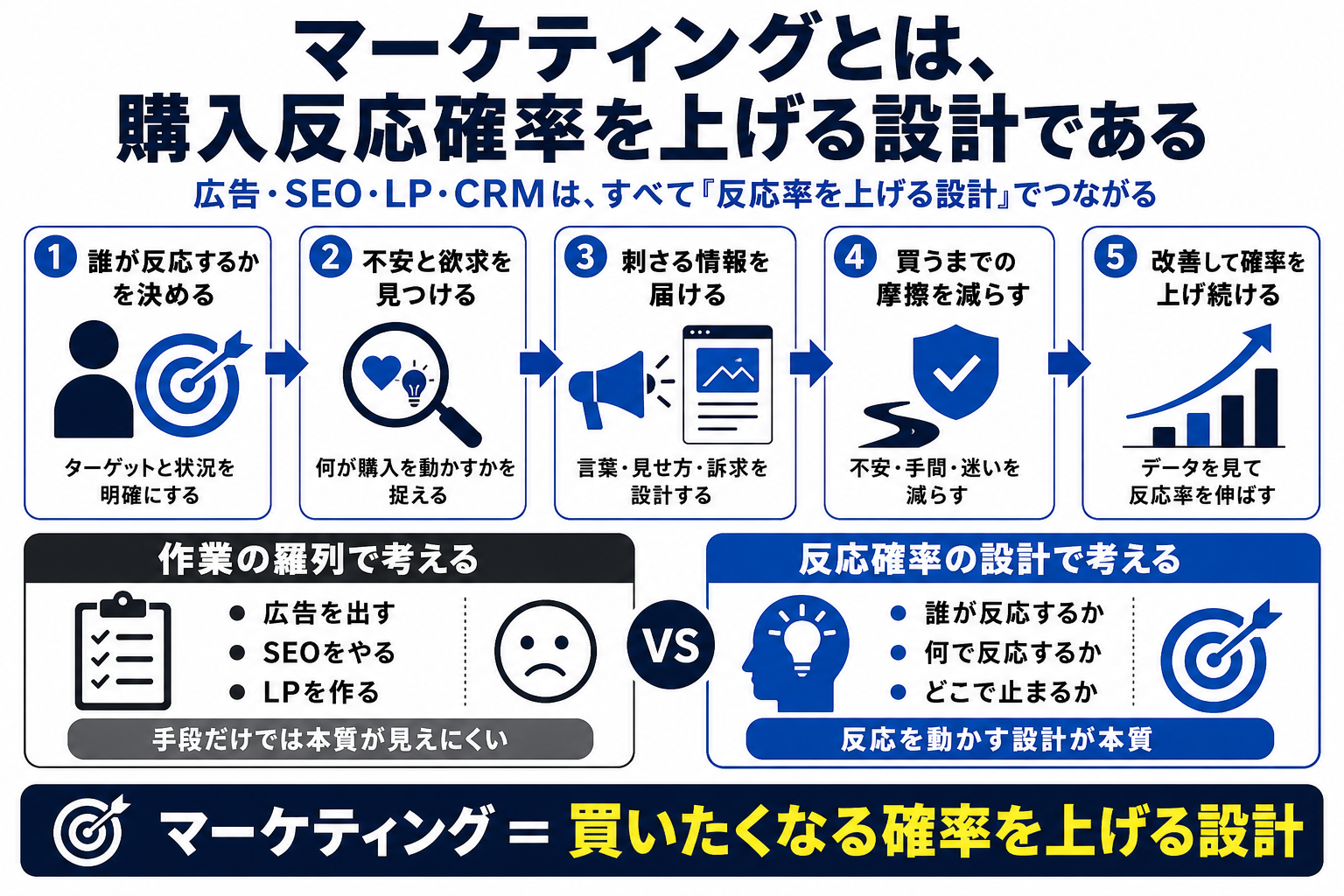
The purpose of marketing is not to increase the number of tactics. It is to find which anxieties customers react to, which evidence reassures them, and which path brings them closer to purchase.
Personas exist to find response conditions, not to introduce fictional people
When people create personas, they often define age, gender, job, and family structure in detail. But those details do not directly create purchase behavior. What matters is what the person reacts to.
Even for the same product, the information that resonates differs between someone worried about bad breath, someone focused on illness prevention, and someone anxious about maintaining a habit. A persona should organize response conditions, not merely describe a person.
Marketing is not the work of classifying people. It is the work of finding the conditions under which behavior changes. If this is misunderstood, detailed persona settings increase without leading to sales.
Look at tactics
- Look at task speed
- Look only at outputs
- Ignore reactions
Look at response probability
- See who reacts
- Design around reactions
- Evaluate tactic probability
The purpose of marketing is not to increase tactics. It is to find the conditions customers react to and raise purchase probability.
A landing page is not a place to line up information; it is a place to create reactions in order
Listing product features from top to bottom will not create a reaction if the order does not match the customer's psychology. The same information changes effect depending on whether the first need is empathy, verbalizing anxiety, proof, comparison, price, or something else.
A landing page is not an explanation document. It is a path of reactions. The reader should feel, 'This is my problem,' then 'This product seems trustworthy,' and then 'It may be okay to buy now.'
That is why landing page improvement should look not only at visuals, but also at psychological order. Which anxiety is resolved first, which proof appears where, and when the CTA is placed are all part of designing response probability.
- Look only at outputs
- Leave no flow behind
- Start from zero every time
- Look at people likely to react
- Design the stimulus
- Judge by probability
Advertising and SEO are experiments for finding response conditions
Advertising is not only for increasing traffic. It is also an experiment for learning which appeal is clicked, which headline creates interest, and where people leave the landing page.
SEO works the same way. It reveals which information earns trust for a search intent, which comparison axes are read, and which FAQs remove anxiety. An article is both a traffic mechanism and an observation point for customer understanding.
Do not end a tactic as success or failure. Leave behind what response condition became visible. When this is done, ad spend and article production cost become learning data for the next tactic.
List response patterns first, then make the tactics
If you start from tactics, the conversation quickly becomes ads, landing pages, articles, or email. The stronger order is to list customer response patterns first: pains, anxieties, misunderstandings, comparison axes, reasons purchase stops, and proof that gives the final push.
Then decide which pattern needs a landing page, which pattern should receive ads, and which pattern should be answered by an article. Tactics should be made in response to response conditions.
The essence of marketing is not pushing a sale. It is finding the conditions under which customers move. Looking through purchase response probability makes tactic priority easier to organize.
Separate weak use from strong use
Marketing should be reframed not as persona creation or tactic execution, but as the design of finding customer response patterns and raising purchase probability.
Weak use
- Start from the product
- Count tactic volume
- Leave it all to AI
Strong use
- Look at response probability
- Design by response pattern
- Evaluate tactics by probability
Marketing is the work of designing the conditions customers react to
Increasing the number of personas or tactics does not necessarily bring customers closer to purchase. By finding which information customers react to, where they feel anxiety, and what pushes them forward, purchase response probability can be designed upward.
- Marketing as the design of raising purchase response probability
- Listing purchase response patterns in advance
- Using personas to find response conditions