I Set Out to Build a Fortune-Telling Site,
career assessment serviceand Ended Up with a
Career Turning Point Journal, built with AI in two days
It began as a casual thought: “Maybe I’ll make a fortune-telling site.” As I started building, I realized that fortune-telling alone might not help people make practical decisions, while career information alone might not address how they feel. So I built a free assessment that brings emotions and real-world considerations together in one UX, taking it from concept to launch and measurement in about two days.

It Started with “Maybe I’ll Make a Fortune-Telling Site”
At first, the idea was simply to make a fortune-telling site while trying affiliate marketing on my own. Around that time, I was also thinking about changing jobs and how I wanted to work in the future. In a conversation with my younger sister, I heard that she was uncertain about her career and whether to change jobs after having a child in her late thirties.
Someone may want to change jobs but struggle to take the final step. They may look to fortune-telling to ask whether the timing feels right. Others may start thinking about how they work for the first time because a reading prompted them to do so.
As I built it, I realized that a service allowing people to move in both directions—from fortune-telling to career questions, and from career questions to fortune-telling—might better reflect their actual uncertainty. From that point, it became more than a fortune-telling page.
Fortune-Telling Alone Doesn’t Resolve Practical Decisions
Fortune-telling can prompt people to reconsider their traits and feelings from a different angle. But concluding “I should change jobs because my luck is good” leaves out practical considerations such as living expenses, work hours, job requirements, and past experience.
Career assessments and job listings alone can also leave some people struggling with the final step. Even when comparing conditions makes a move seem rational, a person may not be able to decide until their concerns and sense of conviction are addressed. Life decisions involve both rational judgment and emotional acceptance.
Fortune-telling helps people sort through their feelings.
Job listings help people check the practical realities.
The user makes the final decision.
Making the Intersection of Fortune-Telling and Career Questions Two-Way
Career Turning Point Journal does not prescribe a single entry point. Someone already looking at job listings needs different information at the outset from someone who has not yet put their thoughts into the words “changing jobs.” The two routes meet in the assessment results, so either path helps users consider both feelings and practical circumstances.
From Career Questions to Fortune-Telling
- I want to change jobs
- Start looking at job listings
- The conditions seem workable
- Still feel uncertain about the final decision
- Use a reading to reflect on personal traits, timing, and feelings
- Make the final decision for myself
From Fortune-Telling to Career Questions
- Feel unsettled about work
- Haven’t decided whether to change jobs
- Check a reading or horoscope
- Notice a mismatch with how I work now
- Explore career options
- Review job listings, the market, and working conditions
Introducing Career Turning Point Journal
This free assessment is primarily for women in their forties and fifties who are weighing whether to stay in their current job, change jobs, or reconsider whether their current way of working suits them. No account is required. Birth dates and answers are processed in the browser; assessment data is neither stored nor sent to an external service.
The live version is designed for women, so it does not ask for gender. It does not infer family circumstances from a user’s age or gender; it uses their work situation and the concerns they choose to share.
The Assessment Became More Complex as I Built It
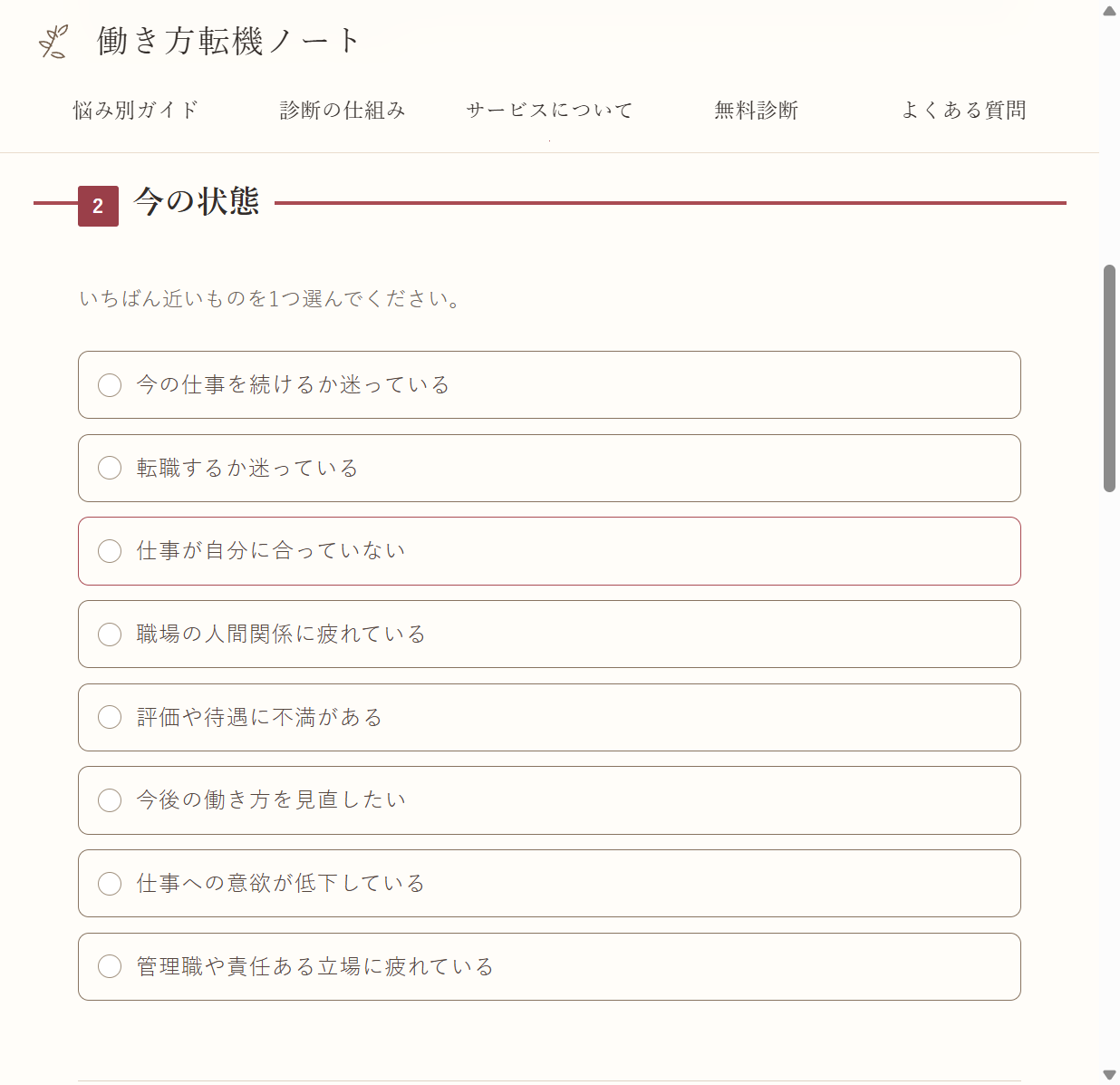
The result does not stop at “You are Type X.” It combines Four Pillars of Destiny calculations with a user’s chosen concern, five checks on their current situation, current role, and job-change readiness, then connects those inputs to useful information they can explore next.
- Personal traits through the lens of Four Pillars of Destiny
- Four current-situation types
- A summary of the selected concern and five answers
- A small step to take today
- Potentially suitable roles and why they may fit
- How current experience could transfer
- What to check in job listings
- Workplaces where someone may thrive—and those to avoid


Complex Behind the Scenes, Simple on the Surface
The assessment handles many conditions internally, but the user’s task is essentially to choose answers, view the result, and select what they want to learn next. I did not want a diagnostic tool that required users to understand complex logic before they could use it.
I did not create a large UX specification or persona documents before starting implementation. Drawing on repeated work in marketing, UX, e-commerce, and website optimization, I translated judgments directly into the interface and logic: “This is where someone may get stuck,” “This answer calls for this next,” “Show the conclusion first here,” and “Only show specialized fortune-telling details to people who want them.”
In retrospect, the work can be mapped to concepts from Google UX Design, including Empathize, Persona, User Story, Customer Journey, Problem Statement, How Might We, Value Proposition, and Decision Flow. I was not ignoring these frameworks. I think repeated practice had made some of them intuitive.
In Two Days, I Built a Working Service, Not Just a Proposal
The work completed in about two days was not just a single HTML page. It was the end-to-end process of turning an idea into a product that could be launched and tested.
I Didn’t “Leave Everything to AI”
I used AI extensively, but it did not decide the service’s purpose or finish the product on its own. The division of work between the human and AI was closer to this:
Set the problem and decision criteria
- Problem definition and concept
- UX, inputs and outputs, and assessment structure
- Decide what to accept and spot what feels off
- Review and make final quality decisions
Speed up implementation and iteration
- Code and implementation proposals
- Large sets of conditional logic
- Support revisions and testing
- UI implementation and iterative improvements
I treated AI less as a “page-making tool” and more as a team member that greatly increased implementation speed. I provided the goal, constraints, and decision criteria, reviewed the output, described what felt wrong, and asked for revisions. That back-and-forth was central to the work.
Connecting Git, Cloudflare, GTM, Analytics, and Search Console
For an independently built product, showing a screen is not enough. It becomes testable only when it can be updated, rolled back if it breaks, and measured after launch.
| Implementation | Vanilla HTML, CSS, and JavaScript. The assessment and Four Pillars calculations run in the browser; no external assessment API or database is used. |
|---|---|
| Four Pillars of Destiny | Implemented calendar calculations including solar-term boundaries, natal charts, hidden stems, ten gods, decade cycles, annual cycles, and work readings. Tests cover ordinary dates and boundary dates. |
| Quality assurance | Added Node.js unit and consistency tests plus Chromium end-to-end tests; GitHub Actions runs the same checks. |
| Deployment | Track changes with Git and GitHub, generate a Cloudflare Pages build, and serve it on a custom domain over HTTPS. |
| Measurement | A dedicated GTM container sends only approved events—such as assessment starts and completions and outbound clicks—to GA4. Birth dates and assessment answers are never sent for measurement. |
| Search | Configured the title, description, canonical URL, structured data, sitemap, and robots settings so post-launch search performance could be checked in Search Console. |

The Biggest Change Was the Speed of Testing a Hypothesis
In the past, connecting planning, UX, design, development, testing, launch, and measurement could take weeks or months. This time, rather than stopping at a proposal, I turned the hypothesis that fortune-telling and career questions might intersect in people’s decisions into a working web service in about two days.
After launch, I can track visits, assessment starts and completions, and outbound clicks. Only then can I get answers from the market. AI shortened more than the time spent writing code.
I see shortening this entire cycle as one of the main benefits of using AI for independent development.
I Don’t Know Yet Whether It Will Sell
I turned the concept into a product. But whether it resonates with the market, can earn affiliate revenue, or can become a viable business has not yet been tested.
Building it in two days is very different from succeeding in two days. What I can say is that I made the hypothesis ready to test in the market. Success will depend not on build speed, but on the response after launch and what I change based on it.
What I Gained in Those Two Days Will Remain
Even if the project does not generate significant revenue, I will retain the experience of turning a hypothesis into a real product, implementing its UX and assessment logic, connecting Git to a live environment, and setting up marketing measurement.
This could not have worked through expertise in fortune-telling, career information, or coding alone. I had to identify a user problem, connect different fields, simplify the user experience, and make the product testable after launch.
What remains is not just a web page, but the connection between planning, UX, decision criteria, implementation, and validation. Whether viewed as a record of the work or a foundation for testing another hypothesis, the project was valuable.