How to Safely Test Business Tools Without Real Data
When you want to build an AI tool to improve business operations, the first challenge is managing information.
Using real data would make development easier, but confidential company information, personal data, contract details, and sales figures cannot be carelessly sent to an external environment.
Still, the lack of real data does not mean that nothing can be tested.
What matters is abstracting and testing the structure of the work, rather than using the real data itself.
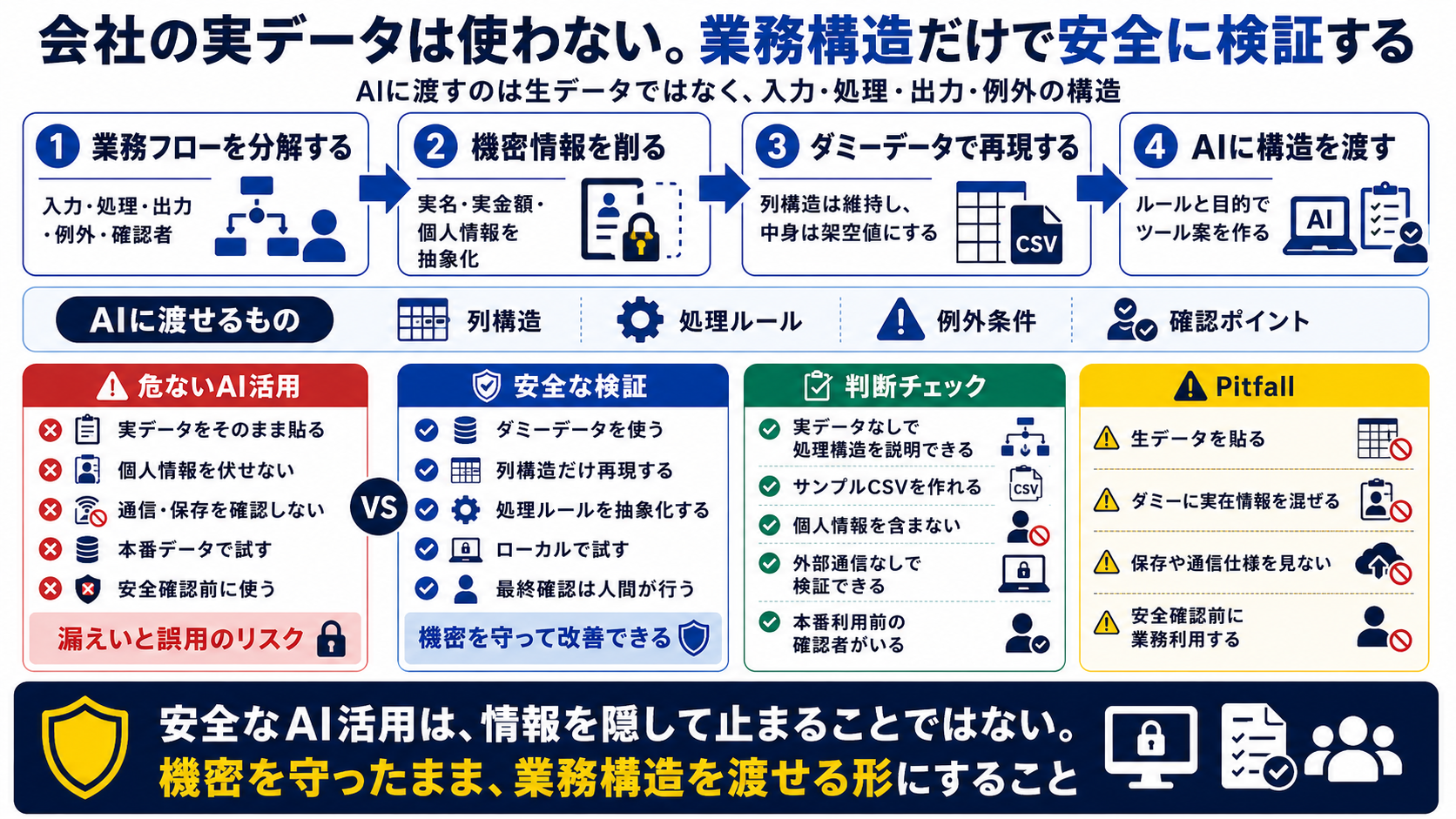
The Work Structure Can Be Recreated Without Real Data
For example, the column structure can be reproduced using customer ID, date, status, amount, owner, and processing result—even without real customer names or sales figures.
Replacing real names with fictional ones, using dummy amounts, and generalizing product names can reduce sensitivity while preserving the workflow.
What we should give AI is not raw company data, but the inputs, processing steps, outputs, exception conditions, and review points.
This helps AI understand how the work is structured and suggest tools, checklists, or process flows.
Process Rules Matter More Than the Data Values in Process Improvement
For many business tools, what matters is not the actual data values, but which columns to read, under what conditions, and how to process them.
Examples include extracting rows with an unprocessed status, prioritizing older dates, matching IDs between Files A and B, or listing any differences.
These operations can be tested without exposing real data.
Abstracting only the process rules can make the result easier to reuse as a general-purpose tool beyond one specific business process.
Safe Testing Requires Dummy Data and Clear Constraints
Dummy data alone is not enough to use AI safely.
We need to decide what information to exclude, which environment to use, whether external connections or storage are allowed, and who will review the tool before any production use with real data.
For internal tools in particular, strong constraints include running locally, testing with sample data, excluding personal information, and avoiding external APIs.
Following these constraints makes it much easier to test process improvements that use AI.
Abstraction Helps People Delegate Work to AI Safely
The ability to delegate work to AI is not the ability to paste in all the information.
It is the ability to remove confidential details, preserve only the process structure, and turn it into a form AI can understand.
This matters both for information management and for process improvement.
In the AI era, practitioners need the ability to abstract work processes and give them to AI without exposing confidential information.
What you should give the AI is
Give AI the work structure, not the company’s real data.is.
A Different Perspective on the Same Topic Changes What We Do
This is not just about efficiency; it changes how we view work itself. Separating what people should handle from what can be built into a system makes practical decisions easier.
- Paste in real data as is
- Leave personal information exposed
- Fail to check external connections
- Leave data retention undefined
- Test immediately with production data
- Use dummy data
- Reproduce only the column structure
- Abstract the processing rules
- Test locally
- Have a person perform the final review
In Practice, This Sequence Makes the Idea Easier to Apply
Here is a process for turning the idea into practical process improvements, tools, or articles instead of leaving it as an abstract concept.
A Checklist for Applying the Idea at Work
Turn the idea into points that are easy to check in practice, so it does not end with reading the article.
Signs That May Point to an Improvement
- I can explain the process structure without real data
- I can create a sample CSV
- The sample contains no personal information
- I can test without external connections
- Someone will review it before production use
Failure Patterns to Avoid
- Paste raw data without abstracting it
- Mix real information into dummy data
- Fail to check the tool’s data retention or network behavior
- Use it for business before verifying safety