The Shift to Index-Based Memory in the AI Era
As more tasks and workstreams run in parallel, it has become difficult to keep every decision and its context in my head.
I have started using “index-based memory”: instead of remembering everything, I keep clues that lead me back to the information I need.
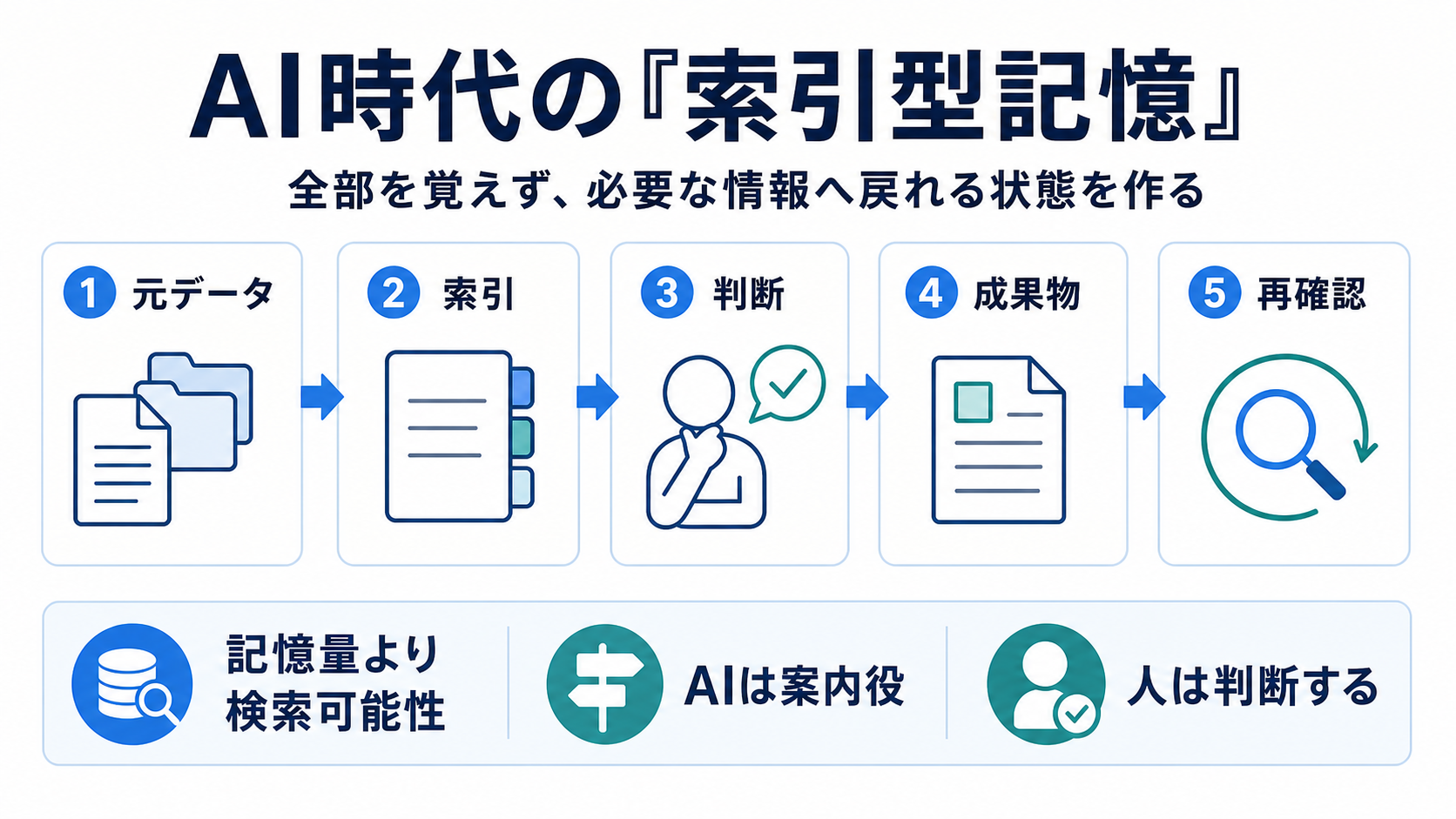
Memory alone cannot keep up with parallel work
At work, multiple e-commerce channels, logistics, data analysis, UI and UX, and compliance can all be active at once. On my own, I work with AI agents, Git, website production, data collection, and writing. Another decision often begins before one project is complete.
I can read information, understand its structure, and make a decision in the moment. But there is too much context and detail to keep in mind across every project. Relying on memory alone means retracing the history whenever I want to reuse a past decision.
Index-based memory means keeping a path back to information
Index-based memory is a way to keep clues that lead back to information instead of holding every detail in your head. Keep project names, dates, decisions, and storage locations in an index; leave the full details in source documents and chats.
Even if I cannot recall past work from memory, a document or a specific name may bring the context back. What is missing may not be the memory itself but a way to retrieve it. With a clear entry point, work can resume without retaining every detail.
How the use of memory changes with AI
Before AI became part of work, the focus was on remembering useful knowledge and past context. Even when documents existed, I needed to know where information was and recall it myself.
With AI and work logs, I can keep details externally and retrieve them when needed. People do not need to remember the full text; they need an index that leads back to the information.
To resume an old project, follow the index to the original chat or document. If the entry point is unclear, ask AI to find likely sources from the surrounding context. Then check the original information and decide whether it still applies.
Use AI and work logs as a second memory
Index-based memory depends on external storage.
Chat histories, daily reports, Git commits, design documents, and an insights database can all serve as external memory. The key is not merely to save information, but to make it searchable later.
A note with only a date is hard to retrieve. Briefly record what was decided, why, and what remains unresolved. If AI will read it, separate the context, objective, and conclusion.
AI is less a memory itself than a guide that finds the right place in a large external memory.
People can focus on judgment instead of retention
Externalizing details changes the human role.
Instead of remembering everything, decide what matters in the current situation. Check whether conditions have changed rather than reusing old decisions as-is. Choose a sound option from those AI finds.
Work can run better even when it feels like you know less. External systems make up for what is no longer kept in memory, letting people focus on structure and judgment.
This is less a loss of ability than a change in how ability is allocated.
External memory has weaknesses too
Of course, externalizing everything is not the answer.
If there are too many storage locations, it becomes hard to know where anything is. An unsearchable image, a meaningless filename, or a note without context may be unusable even if it exists. A service might also shut down, or an account may become inaccessible.
If you keep only an AI summary, the original context and your own words may disappear.
Keep three things separately: the source data, a short index, and the final decision. Record what you chose, not just what the AI wrote.
Design for recall
At a minimum, an index-based memory system should preserve five things:
- When it happened
- What it concerned
- What was decided
- Why the decision was made
- Where the source material is stored
These five details make it easier to return to a topic even if you have forgotten the specifics. By contrast, storing many full-text records is not helpful if there is no entry point.
The purpose of a record is not to preserve everything. It is to help your future self pick up where you left off.
Accept working without remembering everything
When information keeps growing, trying to remember everything the old way can lead to blaming yourself.
But if the work is getting done, your way of using memory may have changed. You may retain less in your head and work through a system that includes external memory and search.
What matters is not appearing to remember everything. It is being able to find the right information when needed and make a decision under current conditions.
Turn index-based memory into an information structure
External memory does not work just by adding more storage locations. The important thing is to define a consistent path from when information is created to when it is reused.
| Layer | What to keep | Purpose | Example |
|---|---|---|---|
| Raw | Original conversations, documents, data, and screens | Return to the source facts | Full chat, CSV, meeting notes |
| Index | Date, topic, project name, short summary | Create a retrieval entry point | “Rakuten launch / shipping design / July” |
| Decision | Decisions, reasons for rejection, and conditions | Reuse decisions | “Exclude Amazon prices from history” |
| Artifact | Deliverables used in practice | Resume the work | Specifications, tools, articles, checklists |
| Review | Changes, deadlines, and review conditions | Update old decisions | “Review again if the terms change” |
Keeping only full text means rereading long documents every time. Keeping only a summary makes it impossible to return to the source when AI misinterprets it. Keeping only the decision means you cannot check the reasoning when conditions change.
Separating these five layers makes it possible to keep both short information for quick recall and longer material for verification.
Common ways index-based memory breaks down
1. Each topic is stored in a different place
If work is in Notion, personal projects are local, decisions are in ChatGPT, and URLs are in browser bookmarks, remembering where to search becomes work of its own. Even if you cannot centralize every storage location, bring the index together in one place.
2. Titles are too abstract
Titles such as “discussion,” “meeting,” or “review” are hard to distinguish months later. Include the subject and decision, for example, “Reverse-engineering Amazon statement calculations” or “Shipping terms for Rakuten launch.”
3. Treating an AI summary as fact
AI can organize a conversation neatly, but it may present tentative statements as conclusions. Always link a summary to its source, and have a person restate important decisions briefly.
4. Search terms do not match your own words
If you later search for “the workload increase” but the only saved category is “process efficiency,” the record will be hard to find. Keep the official name as well as the words you are likely to search for later.
5. No review date
Policies, prices, tool specifications, and organizational structures change. Information that was correct when saved may not remain correct. Add a date or condition for reviewing information that may become outdated.
Daily and monthly operating rules
You do not need to organize everything perfectly every time. Maintain index-based memory in two stages: when information arises and during periodic reviews.
When information arises
- Save the source data without deleting it
- Write the topic in one line
- Extract only what was decided at the time
- Add a link or conversation ID to return to the source
- Store personal and confidential information separately
Monthly review
- Combine indexes on the same topic
- Mark outdated decisions for review
- Move unused notes to a holding area
- Link information that became a deliverable
- Promote only decisions that will still be useful next month
The point is not to outsource memory completely. It is to use external information so your present self can make a decision again. An index is not an answer; it is an entry point for reconsideration.
Use the words you would search for in the index
An impressive category name is no use if you cannot remember it later. Keep terms you are likely to search for: phrases from the conversation, project names, people, symptoms of a failure, and decision dates. In addition to “API integration,” index concrete phrases such as “prices cannot be retrieved” or “excluded Amazon from history.”
Do not trap a record in a single folder; make it retrievable by project, topic, or status. Consistent titles and short summaries are more useful for search than perfect categorization. You can reorganize categories later as long as the source location and decision rationale remain.
Choose the source of truth before giving it to AI
If the same information is scattered across chats, notes, documents, and code, AI may not distinguish an old proposal from a final decision. Choose one place for the adopted specification, published article, or current procedure. Use chats to keep the deliberation and the source of truth to hold the current answer.
When asking AI to find past information, specify the scope and dates, and require it to cite its sources. Do not mistake a plausible reconstruction for recovered memory. Verify important contract terms, figures, and published content in the original files.
Treat forgetting as a signal to review the system
If you repeatedly cannot find something, fix the index before blaming your memory. Names may vary, summaries may be missing, decisions may be mixed with drafts, or there may be too many storage locations. Correct these issues one by one. The experience of forgetting is itself a test that reveals flaws in the external memory system.
At the end of each month, review only important new decisions and deliverables, and remove unnecessary intermediate files from the source of truth. You do not need to reread everything. Maintenance means checking whether you can return to the original decision within minutes when the same issue comes up again.
Conclusion
In the AI era, memory is shifting from how much you can remember to how easily you can return to the information you need.
Assume you will forget: keep logs, add an index, and use AI to search. People make decisions based on what it finds.
Feeling that your memory has declined does not necessarily mean your ability has declined. The division of work between your brain and external memory may have changed to handle more information.