Using generative AI is like
training a new hireThe more you teach AI your criteria,
the more it can work without detailed instructions
When I first started using generative AI, I gave detailed instructions on what to research, how to evaluate it, what order to follow, and what format to use.
But as I built up reference knowledge and decision criteria, I had less to explain each time. Now, I can often provide the goal and broad direction, and AI develops the key points, prioritizes them, and turns recommendations into a deliverable.
This change resembles how I once trained new hires as a manager. The more I helped someone develop decision criteria instead of merely teaching tasks, the more instructions shifted from procedures to outcomes.
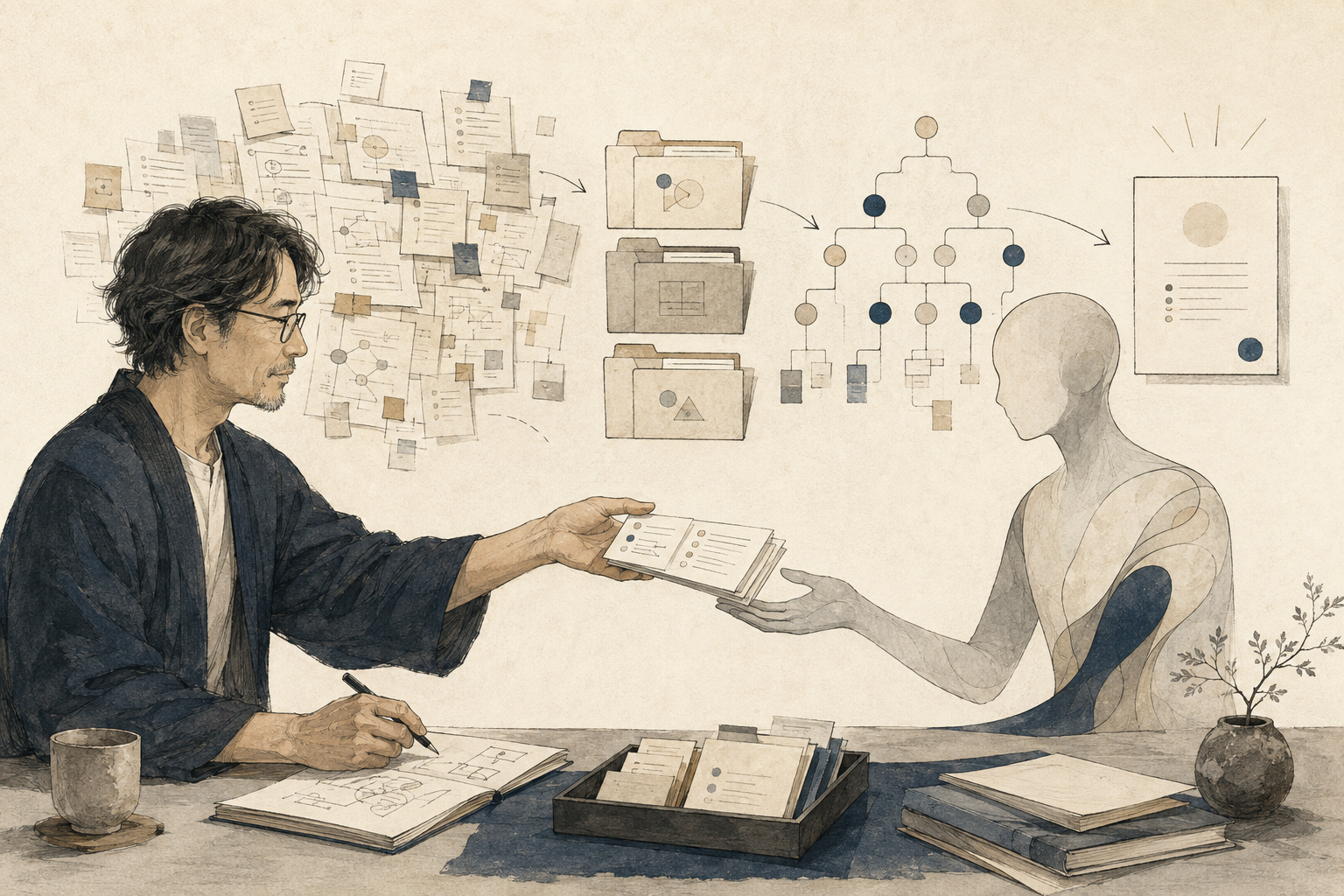
Good AI training is not about writing long prompts.
Preserve what you notice and how you make decisions in a form AI can use.
The job is more than teaching procedures
When assigning work to a new hire, you do not begin with, “Here is the goal; take it from here.” You explain the purpose, what to check, priorities, the scope of their authority, prohibitions, when to ask for help, and past mistakes.
At first, you review deliverables closely. You might clarify, “Prioritize this in this situation,” “Do not draw a conclusion from this number alone,” or “Do not use that wording under these conditions.”
What is this work meant to accomplish?
What should be checked and prioritized?
What can the person decide, and when should they ask for help?
What is prohibited, and what has gone wrong before?
As the manager's decision criteria take root, instructions can become shorter. Good training is not just explaining how to do a task; it enables someone to make decisions in light of the goal.
AI is a capable new hire who does not know your organization
Modern AI starts with broad general knowledge and strong baseline skills. But it does not know your organization's rules, industry norms, past failures, your evaluation criteria, or internal red lines.
If you assign work in that state, AI will return a reasonable answer that may still miss your expectations. This is not a lack of capability; it lacks the local context needed to make the right judgment.
It has strong baseline skills but does not know your company's or your own criteria. The answer may look correct while remaining generic.
It refers to the goal, evaluation criteria, red lines, and past examples to work out what it needs to consider.
It identifies key points, ranks their importance, and organizes improvements into a deliverable ready for final human review.
Turn a mismatch into a decision criterion for next time
When an AI response feels off, simply saying “fix it” can lead to the same mismatch again. The important thing is to explain why it was wrong.
Suppose a landing-page review is sound from a marketing perspective but weak from a UX perspective. Rather than simply adding “check UX too,” record the actions to assess, conditions that make something unacceptable, priorities, and how the review connects to the business goal.
As AI learns, delegation shifts from tasks to outcomes
Early on, when there are few shared criteria, people decide the key points, evaluation criteria, and process, give detailed instructions, and review almost everything. AI's role is limited to generating what it was told to make.
As the criteria grow, people can focus on the goal, constraints, and final decision. AI can identify the issues, evaluate them from several perspectives, prioritize problems, and turn improvements into a deliverable.
People define the process
- Set the key questions and evaluation criteria
- Specify the research and production steps
- Review the output in detail
- Explain each correction as it comes up
AI develops the process
- Identify the issues needed to meet the goal
- Refer to the relevant evaluation criteria
- Detect problems and rank their importance
- Turn recommendations into a deliverable
This does not mean handing over responsibility. People still set the goal and constraints, review the result, and decide whether to use it. What changes is how much of the work in between can be delegated to AI.
A short prompt does not mean careless use
A short AI prompt can look like a careless handoff. In reality, it may be short because expertise, past decisions, red lines, successes and failures, evaluation criteria, and reference routing have already been prepared.
“Check A, research B, compare it with C, and prepare the materials in this order and format.”
“I need to make this decision at next week's meeting. Prepare the materials we will need.”
Move the decision process from one-off prompts into durable reference knowledge. You avoid repeating the same explanations not by skipping them, but by first preserving them in a reusable form.
Give AI decision material, not just answers
You do not need to create a massive manual all at once to train AI. Capture small decision rules that recur in everyday reviews. Start with these seven:
Purpose— What is the work for, and what decision should be made at the end?
Evaluation criteria— What should be reviewed, and how do you decide what is good or bad?
Priorities— When criteria conflict, which one takes priority?
Red lines— What is prohibited, or makes a result unacceptable?
When to escalate— When should AI stop and hand a decision back to a person?
Examples of success and failure— What has worked in the past, and what caused problems?
Reference routing— Which knowledge or rules should be consulted for each task?
With AI, training must be preserved as data
AI does not permanently improve because you corrected it once, the way a human employee might. A correction made in one conversation may not carry over automatically to another task.
Decision criteria you want to preserve must be externalized explicitly as reference knowledge, memory, database entries, or project rules. You also need a way to select relevant criteria for each task instead of asking AI to read everything.
Training a person relies heavily on implicit learning through conversations, observation, and experience.
Training AI requires tacit knowledge to be turned into words and data, then kept somewhere it can be consulted when needed.
Conversely, a well-designed external knowledge base turns past experience into a first-pass review that is less affected by fatigue or memory. Even when you are busy, AI can use criteria you have already organized to check key issues.
Train a first-pass reviewer that uses criteria close to yours
As a manager, I focused on helping more people make decisions using criteria close to mine, even when I was not there. The goal was not to create an exact copy of me, but to share how to make decisions so others could act independently.
The same is possible with AI: gradually externalize your expertise, what feels wrong, red lines, priorities, and past failures. AI can then move beyond a general answer engine and become a work partner that can refer to how you usually make decisions.
AI's output is still only a first-pass judgment. People remain responsible for the final decision and its consequences. The value lies in delegating the organization of decision material and the intermediate steps while keeping that boundary clear.