When multiple AIs run in parallel,
human review becomes the bottleneck.
I can ask Codex to update a site, have another AI build an app, and run video processing in the background while I think through the next requirements.
Work that once had to be done sequentially can now be split among several AI workstreams. Even one person can operate like a small production studio.
But adding more parallel tasks does not make everything infinitely faster.
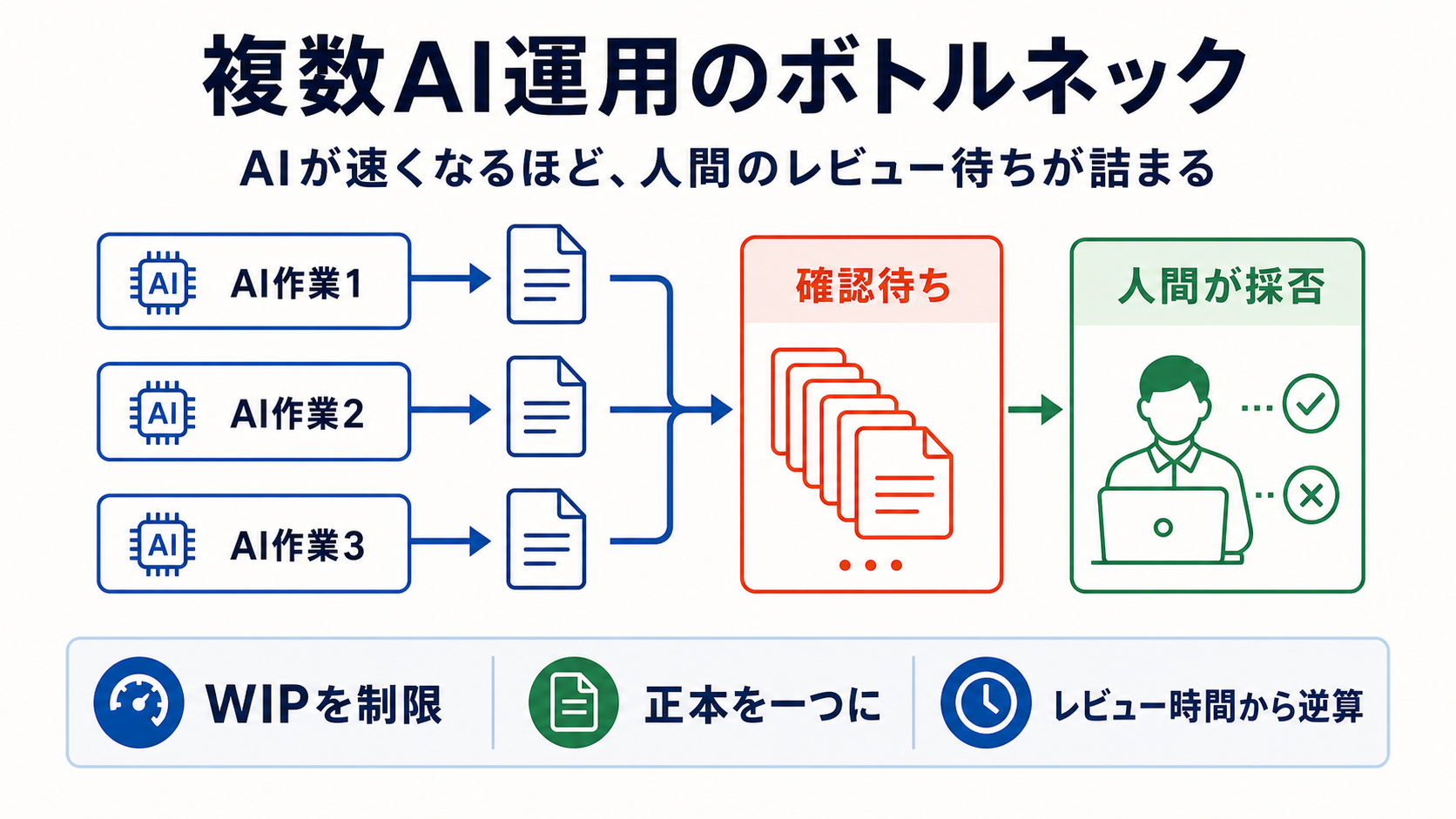
The final bottleneck is
people, not AI.
One person can run multiple workstreams
You do not need to watch an AI agent continuously while it works.
Give it a goal, scope, constraints, and completion criteria, and it can research, implement, test, and revise for hours. Meanwhile, a person can prepare another task.
One day, I worked on a price-comparison site update, a video download, OCR processing for Kindle images, and a summarization app at the same time. One person was directing the work, but several execution streams were active.
This is less like doing five tasks at once and more like supervising several workers.
Why parallel work can feel invisible
A substantial AI task can continue for two or three hours once you assign it.
It may take a person about ten minutes to write the requirements, followed by a waiting period. Since they can switch to another task until a review is needed, it may not feel like they are juggling much.
That is a major difference from parallel work between people.
There are fewer status meetings, repeated explanations, and immediate answers to questions during the work. Because AI can operate asynchronously for long stretches, it is easy to add more streams.
Deliverables return to the person all at once
Problems arise when deliverables from several workstreams return around the same time.
A person still needs to review site rendering, data consistency, app behavior, policy questions, and writing quality. Even when AI reports that it is “done,” someone must decide whether the result can be accepted.
While you are reviewing one item, another AI asks a question and another deliverable is completed. It becomes unclear which revision is current. The review queue grows, and the overall work stalls even though the AIs are idle.
Increasing execution capacity makes review capacity the new constraint.
The bottleneck shifts to review capacity
Before AI, the constraint was the time people had to do the work.
After introducing AI, the heavier work is deciding what to have it make, whether the output is correct, what to accept, and where to integrate it.
In other words, the human role shifts from worker to reviewer.
When increasing concurrency, look beyond computer performance and usage limits. Consider how many deliverables you can review to a sufficient standard each day.
Manage task states, not chat histories
Conversation history alone is not enough to manage multiple AIs.
At a minimum, give each task a state: Not started, In progress, Awaiting review, In revision, or Complete. Also keep a one-line note with its goal, assigned AI, deliverable location, and next human decision.
What matters is making the next item for human review visible, not just tracking what each AI is doing.
If too many tasks are awaiting review, stop assigning new ones. Prioritize completing existing work instead of increasing work in progress.
Do not leave all review until the end
If you let a large task run to completion before reviewing anything, the scope of revisions may grow.
Break review into smaller checkpoints: the initial design, a representative screen partway through, and the full result at the end. This also prevents AI from going in the wrong direction for too long.
But too many checkpoints keep a person on call. Use interim reviews only for decisions that would be costly to reverse.
Decide at the start what can run asynchronously and where a person must stop the process.
Keep a source of truth and a decision log
The biggest risk in parallel work is losing track of which version is current.
Choose one source of truth for each deliverable. Instead of creating more pre-revision copies, manage it somewhere that records changes. Have every AI task refer to the same source of truth.
Also briefly record why you accepted or rejected a proposal. If it comes up again, you will not need to reconsider it from scratch.
As AI works faster, file management and decision records become more valuable.
Set concurrency based on human capacity
Being able to run ten tasks technically does not mean you need to run ten.
If you can carefully review three items a day, keep the review queue at three or fewer. Reduce concurrency for high-stakes work, and run only simple conversions or long processes in the background.
Do not maximize the number of AIs; maximize concurrency while preserving human judgment quality.
Measure the review queue
If you manage multiple AIs by intuition alone, you may have capacity when assigning work but receive a wave of deliverables a few hours later. Estimate the required human review time for each task in advance, not just its implementation time.
| Example task | AI work time | Human review time | How to handle concurrency |
|---|---|---|---|
| Long video conversion | 2 hours | 5 minutes | Easy to run alongside other tasks |
| First draft of an article | 40 minutes | 30–60 minutes | Do not run too many at once |
| Full UI redesign | 2–4 hours | 60–120 minutes | Reserve review time for one at a time |
| Data migration | 1–3 hours | 30–90 minutes | Diff and recovery review are essential |
| A specification change affecting terms or policy | 1 hour | 60+ minutes | Prioritize human judgment and reduce concurrency |
A task is easy to run in parallel if AI takes a long time but human review takes only five minutes. Conversely, having AI write ten drafts in twenty minutes each creates a ten-hour review debt if each draft takes an hour to read.
Set concurrency based on review time available today and tomorrow, not on how many AIs can run.
An operating board for a personal AI studio
A minimal task board needs only these fields:
| Field | Description |
|---|---|
| Goal | What this task is meant to improve |
| Source of truth | The only file or branch AI should modify |
| State | Not started / AI working / Awaiting human review / In revision / Complete |
| Completion criteria | What must be checked before it is done |
| Human review time | How many minutes to reserve |
| Risk | Can it be restored if broken? Does it affect production or policy? |
| Next decision | What requires a human decision before work can continue |
Set an operating rule such as Limit the review queue to three. Once three items are waiting, pause new AI tasks and clear the review queue. Put work involving production data, payments, publication, or policies in a separate high-risk lane instead of the regular queue.
If you cannot review a completion report right away, do not send AI ad hoc revision requests. That can shift the source of truth and requirements, leaving it unclear which version you are reviewing. First consolidate the review items, then send the next revision request.
Common parallel-work failures and how to prevent them
1. Multiple AIs edit the same file
One revision can overwrite another. Separate files or branches and assign one person or agent to integrate them. Do not let multiple AIs edit the same source of truth at once.
2. Completion criteria vary by task
AI may consider the task complete when it has written the code, while a person expects the interface to work correctly. Specify tests, visual checks, data integrity, and the deliverable location when assigning the work.
3. Constant replies to questions break focus
If you answer every question in real time, the supervisor becomes the busiest person. Set a rule: answer immediately only when a wrong assumption would be costly; for minor questions, let AI continue with an explicit assumption.
4. The deliverable location is unclear
Do not settle for a description in chat. Have AI return the canonical deliverable location and a list of changes. Update the task state after review to show whether the result was accepted or rejected.
5. Review quality declines
Reviewing many deliverables late at night increases the chance of missing something. Schedule high-risk reviews for the next morning and separate simple visual checks from data and policy reviews.
Parallelizing AI work is not difficult by itself. The challenge is applying consistent quality criteria to multiple deliverables and integrating the right version. Without an operating design, parallelization increases work in progress rather than productivity.
Vary the depth of review by deliverable
Reviewing everything with the same rigor consumes too much human time. A temporary research note may need only source and conclusion checks; an internal tool needs scope and recovery checks; a public article needs a review of facts, wording, duplication, links, and images. The greater the external impact, the deeper the review.
If you define review criteria up front, you can ask AI to provide evidence. For code, request changed files and test results; for articles, source chats and factual support; for images, copy and dimensions. This reduces the time people spend looking for information after the work is done.
Collect completion notices in one place
With multiple chats open, you have to remember where each task finished. Put the task name, deliverable location, state, and next human check in one list. Chats are workspaces, not the source of truth for progress.
Standardize what “complete” means. “Code written” means implementation complete; “tests passed” means verification complete; “a person reviewed it” means review complete. These are different states. Separating them helps prevent an unreviewed deliverable from being mistaken for something ready to publish.
Schedule time for human focus
If you squeeze difficult reviews between meetings or late at night, you are more likely to miss something. Schedule articles, designs, and release changes that need judgment during focused work periods. Automate simple format checks so people can spend their time on claims, meaning, and safety.
Set concurrency based on the number of tasks people can review by the next day, not on the AI limit. If the review queue exceeds capacity, stop generating new work and prioritize reviewing and integrating existing results. This is how parallelization produces outcomes instead of just speed.
Once a week, identify which steps had the longest wait. The response depends on whether AI work was slow, required information was missing, or human decisions were overloaded. If review alone is blocked, do not increase generation; first automate checks and organize evidence in the task request.