Turn That Annoyance into a Tool with AI: The Builder’s Edge
Work contains countless small points of friction.
Checking images, formatting CSVs, converting files, and repeating the same explanations can all be tedious.
In the AI era, builders who turn these frictions into tools and systems are stronger than those who simply endure them.
The value of people who turn complaints into useful solutions will continue to rise.
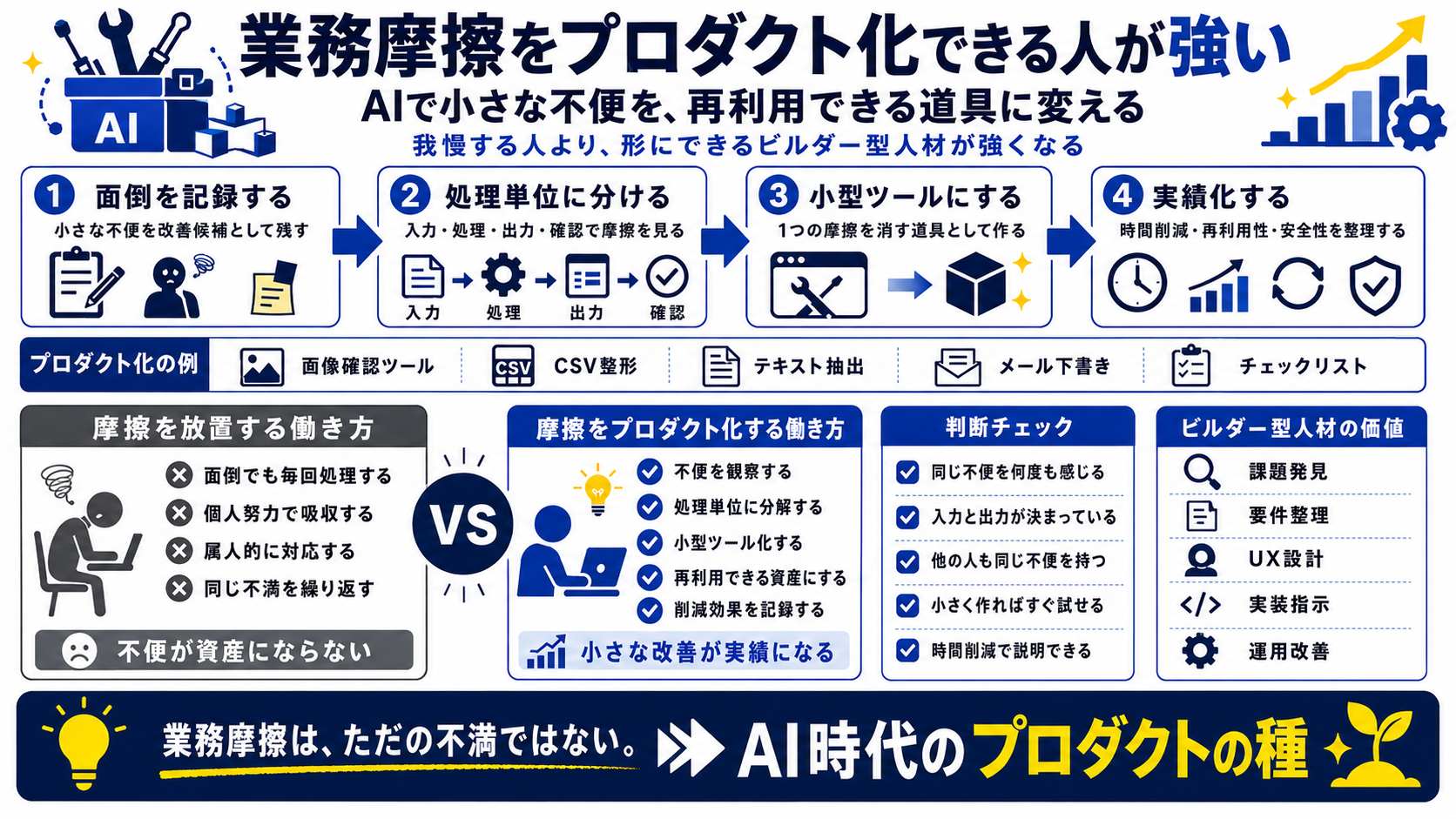
A recurring annoyance may be a candidate for an AI tool
Workplace friction can fade into the background once you get used to it. But a task that feels slightly annoying every time has room for improvement.
Checking images, formatting CSVs, converting files, and repeating the same explanations can all be tedious. These are not just complaints; they may be candidates for tools, templates, or automation.
People who thrive in the AI era do not overlook friction. Rather than putting up with it, they break it down into steps and turn it into a reusable tool.
Removing even one small point of friction can save daily work time, reduce review errors, and cut explanation costs. These improvements add up to both individual accomplishments and organizational productivity.
People who can turn real-world friction into tools are stronger than those who only know AI
More people will learn to use AI. But few can spot where it would make work easier and turn that insight into a tool people can actually use.
That is a major difference. Knowing a lot about AI does not remove workplace friction. What matters is understanding the work, finding friction, breaking it into steps, and turning it into a small tool.
Builders do not start by aiming for a perfect, large-scale system. They remove the small bottleneck in front of them, try the tool, fix it, and improve it again.
People who can move through this cycle quickly are well positioned in the AI era. They can treat problem discovery, requirements, UX, implementation instructions, review, and improvement as one continuous process.
Productization does not mean building a large service
Productization often brings to mind an external service or SaaS. But in practice, a small HTML tool, Chrome extension, spreadsheet helper, checklist, or input template for a team can also be a product.
The important thing is to turn friction into something reusable. Once it works, others doing the same task can use it too.
For example, a small tool could load a CSV and reorder the columns you usually fix by hand, flag filenames that break naming rules, or check image dimensions and extensions in bulk. Tools like these can be highly effective at work.
AI makes it easier for non-engineers to build an initial version. The key is not coding skill itself, but recognizing what to turn into a tool to make work easier.
Turning workplace friction into tools can become a career accomplishment
The experience of productizing workplace friction can become a career accomplishment. It shows more than AI use: it covers problem discovery, requirements, UX design, implementation instructions, acceptance testing, operations, and improvement.
It becomes especially concrete when you can explain the time saved, errors reduced, reusability, and security considerations.
“I built something with AI” is not enough. Explain what friction you found, what work you reduced, who can use the tool, and which risks you avoided.
In the AI era, small improvements like these add career value. Practical examples of turning friction into tools communicate capability better than an impressive title.
The same workplace looks different to someone who complains and someone who builds
Everyone experiences friction. The difference is whether you put up with it or break it down and turn it into something reusable.
- Repeat the tedious task each time
- Absorb the inconvenience through individual effort
- Handle it as an individual
- Never turn the idea into an improvement
- Repeat the same complaint
- Observe the inconvenience
- Break it down into steps
- Build a small tool
- Make it a reusable asset
- Record the impact
Start by turning one point of friction into one tool.
You do not need to build something large. Starting big can inflate requirements and produce a tool that no one uses. Begin by removing one point of friction.
These conditions can indicate a good candidate for an AI tool
Not every task needs a tool. Start with recurring tasks that have clear inputs and outputs and create errors or review burden.
Potential areas for improvement
- The same inconvenience occurs repeatedly
- The task has defined inputs and outputs
- Others experience the same friction
- A small version can be tested quickly
- The result can be explained in time saved
Failure patterns to avoid
- Trying to build a large product from the start
- Failing to break down the cause of the friction
- Ignoring the user’s workflow
- Stopping after the first version without improving it
Being a builder does not mean writing every line of code
People who thrive in the AI era
find work friction, turn it into tools, and preserve those tools as assets.