Turn Small Inconveniences into Product Ideas
An inconvenience you notice is more than a complaint.
It may be the seed of a product for others facing the same problem.
AI has lowered the barrier to building small tools, making it easier to grow a tool you made for yourself into a product you can share.
Before imagining a large service, start by noticing small inconveniences in your own life.
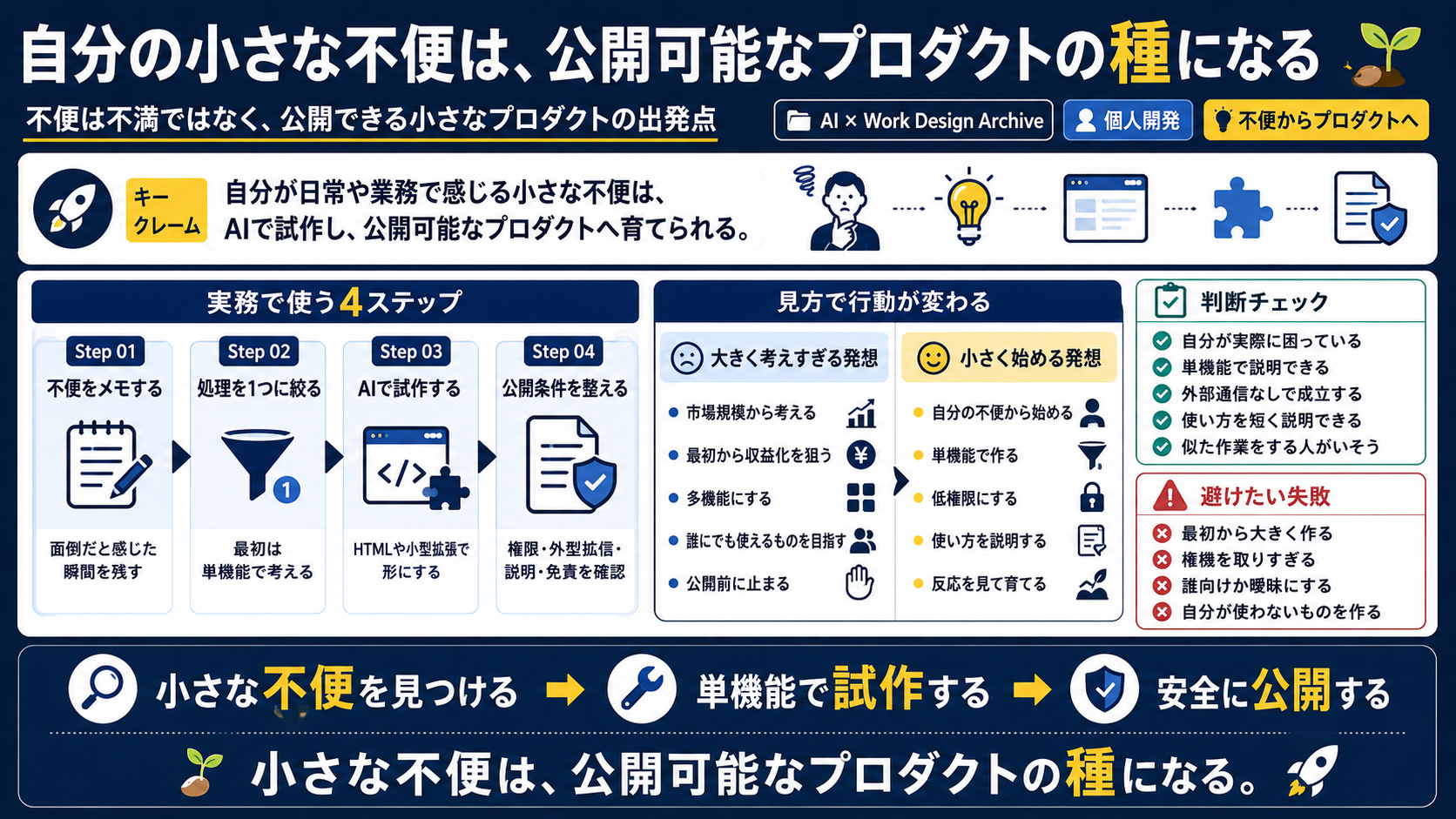
Small Inconveniences Are Concrete Problems
When considering a new service, it is difficult to begin with a huge market or a novel idea.
A small inconvenience you actually experience, however, comes with a concrete use case.
You may want to check how an image renders, extract only the text from a page, clean up a CSV, or standardize filenames in bulk.
These problems are specific and easy to prototype quickly.
A Personal Tool Has a Clear First User
A tool that solves your own inconvenience has an initial user.
That first user is you.
If it helps you, it may also help others who do similar work.
Not every idea will become a large service. But you can publish it on a small scale and see how people respond.
AI Has Lowered the Cost of Prototyping
In the past, building even a small tool required programming knowledge and time.
Today, you can describe the requirements to AI and prototype a single-purpose HTML tool, Chrome extension, or simple converter.
Instead of stopping at the idea, you can test something people can actually use.
A prototype gives you something concrete to evaluate.
Sharing a Tool Requires Safety and Clear Explanations
A personal tool needs more than working code before it can be shared.
Explain whether it communicates externally, what information it stores, its permissions, how to use it, its limitations, and how it handles data.
For Chrome extensions and web tools, it is easier to publish something with limited permissions, a narrow purpose, and no external communication.
Keeping a tool small also makes it safer and easier to explain.
A small inconvenience of your own can become
the seed of a product you can share.
A Different Perspective Can Change What You Do
This is about changing how work is viewed, not just making it faster. Separating what people should handle from what can be systematized makes practical decisions easier.
- Start with market size
- Aim to monetize immediately
- Add many features
- Try to build for everyone
- Stop before publishing
- Start with your own inconvenience
- Build one focused feature
- Limit permissions
- Explain how to use it
- Improve it based on responses
A Practical Sequence
Use this sequence to turn the idea into practical improvements, tools, or articles.
Checklist for Applying the Idea at Work
Turn the article into concrete checks for day-to-day work.
Signs there may be room to improve
- You experience the problem yourself
- The tool has one clear purpose
- It works without external communication
- It is easy to explain how to use
- Others may do similar work
Failure patterns to avoid
- Building something large from the start
- Requesting too many permissions
- Leaving the intended audience unclear
- Building something you do not use yourself