Treat Mindless Repetitive Processing as
Work to Be Reduced
When you are busy, it is easy to mistake the amount of activity for the results of your work.
But tasks such as copying data, converting formats, exporting, resizing, and routine checks may involve little judgment or design.
Rather than asking people to keep pushing through such repetitive work, treat it as work to reduce.
In the AI era, it is important to distinguish meaningful work from routine tasks.
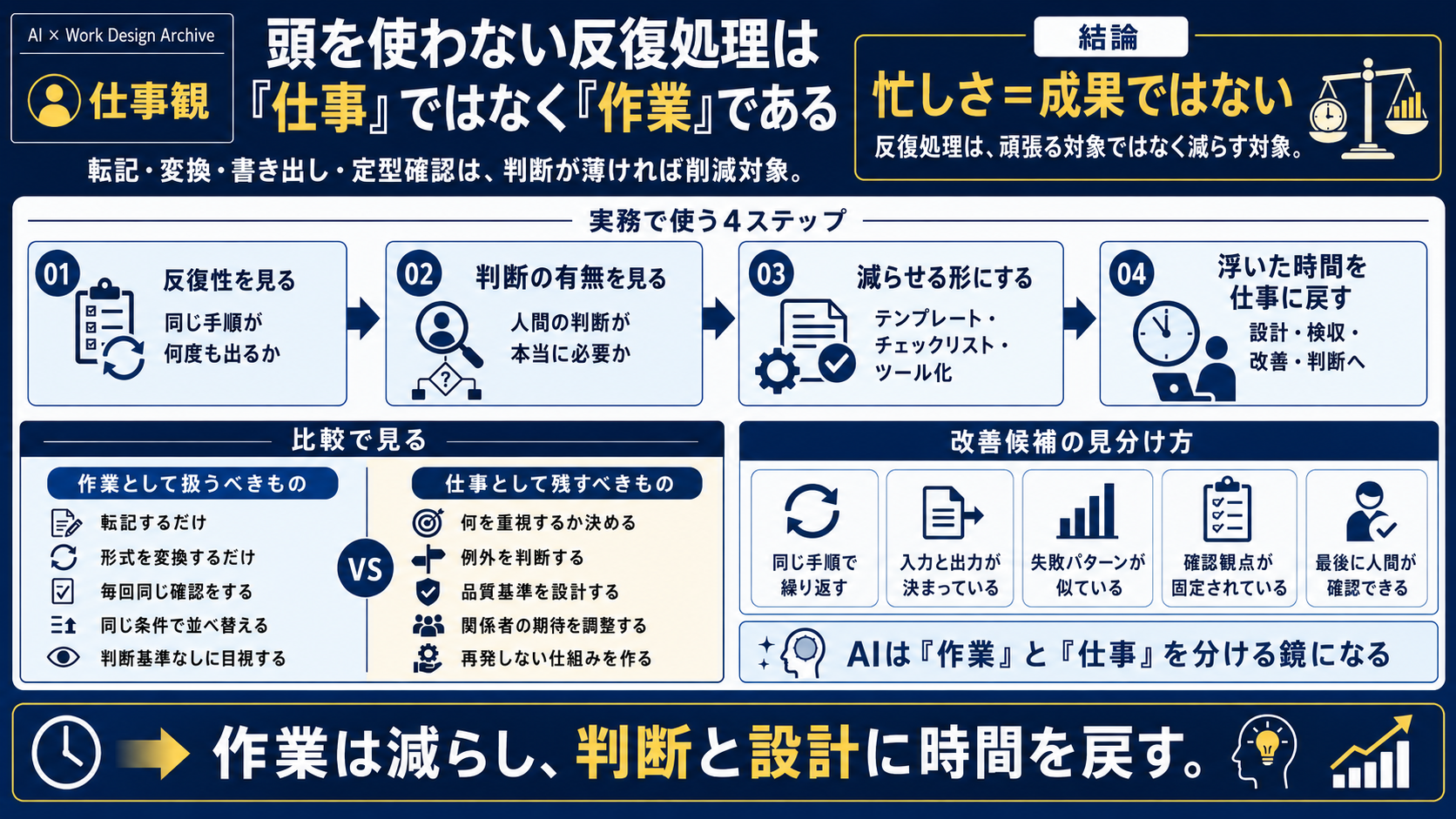
Work involves judgment and design, not just activity
This does not mean that doing the work is worthless. In practice, there is no deliverable without execution.
But we need to distinguish which parts actually create value.
Deciding what to build, setting quality standards, aligning stakeholder expectations, reducing confusion for customers and users, and preventing problems from recurring: this judgment and design work is at the core.
By contrast, recurring tasks such as converting files in the same format, copying the same columns, or visually checking the same items should be handled by a system wherever possible.
Calling every task “work” can stall productivity
When repetitive processing is rewarded as work, it becomes harder to imagine reducing it.
Busyness starts to look valuable, volume looks like results, and people who can shoulder the same tasks for a long time are more likely to be praised.
But what truly benefits an organization is not someone working hard on the task every time; it is making the task easier the next time.
Reducing tasks also reduces review errors, training costs, and handoff effort. People can focus on more important decisions.
AI can help reveal the difference between work and tasks
Give AI a task and it becomes easier to see how much of the process can be standardized.
If AI can easily turn a task into a procedure, people may not need to think through it from scratch every time.
By contrast, the parts that remain difficult for AI to judge may require human experience and contextual understanding.
AI can therefore do more than replace tasks: it can help identify where routine processing ends and meaningful work begins.
Find tasks that can be reduced
Tasks that are easy to separate out share several traits.
They repeat the same steps, have defined inputs and outputs, fail in similar ways, use fixed review criteria, and allow a person to check the result at the end.
Tasks like these are good candidates for templates, checklists, scripts, or local HTML tools.
Tasks involving other people’s feelings, negotiation, accountability, or prioritization should remain human work.
Mindless repetitive processing is
a task to reduce, not meaningful work.
A different perspective on the same topic can change what you do
The question is not simply whether to use AI. Decide which tasks to keep, which to reduce, and which decisions should remain with people.
- Copying data
- Converting formats
- Repeating the same checks
- Sorting by the same criteria
- Visually checking without clear criteria
- Deciding what matters
- Assessing exceptions
- Designing quality standards
- Aligning stakeholder expectations
- Building systems that prevent recurrence
A practical order for applying this idea
Turn the idea into steps that can be applied to real operational improvement.
A checklist for applying the article’s ideas at work
Translate the ideas into practical checks so they do not end with reading.
Potential areas for improvement
- The same task is repeated many times a month
- The procedure can be explained to someone else
- The decision criteria are mostly fixed
- Errors tend to occur in the same places
- A person can check the output
Failure patterns to avoid
- Mistaking task reduction for cutting corners
- Carelessly automating human judgment
- Speeding up processing while ignoring the root cause
- Failing to record the impact of reducing tasks