What sets AI apart is
not prompts, but reference material.
When people try to get more out of AI, they often start with prompts.
Of course, how you ask matters.
But when people use the same model and ask similar questions, their answers start to look alike.
What really creates a difference is not what you ask AI, but what you have it read and use to make decisions.
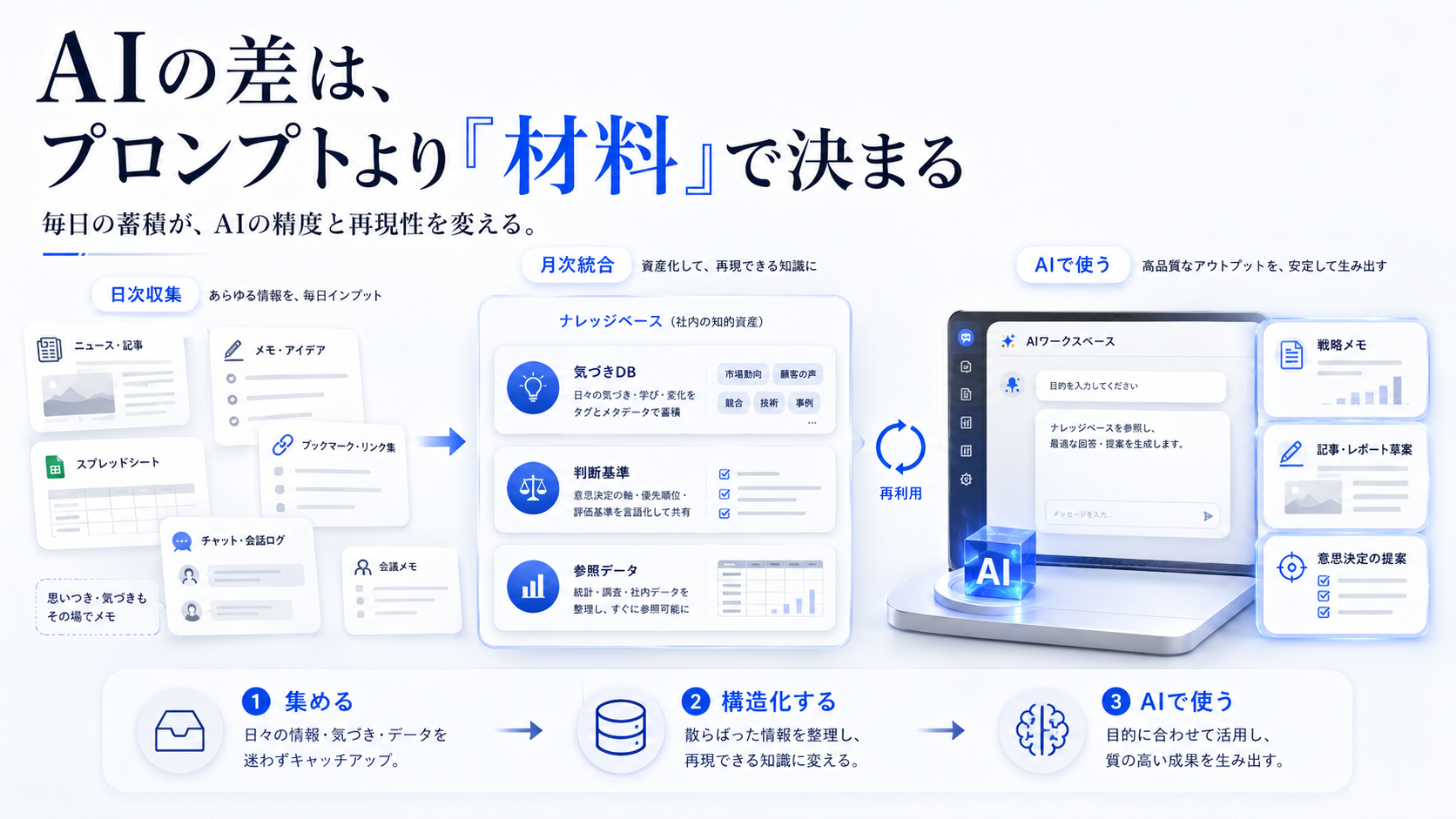
Prompts matter, but they are not much of an asset on their own
When people start using AI, they often begin by refining their prompts.
Give it a role. Specify constraints. Choose an output format. Ask it to create a table, summarize, or compare.
This can certainly help. A careless prompt tends to produce a careless answer, so there is value in asking well-framed questions.
But there is a limit to what prompt refinement alone can achieve.
As more people use the same AI, write similar prompts, and specify similar output formats, the differences gradually shrink.
A prompt is the steering wheel for AI. But a steering wheel alone will not take you far without fuel, a map, or a record of where you have been.
AI's weakness is that it does not know your workplace
AI is good at general knowledge.
In marketing, process improvement, e-commerce, UX, legal topics, and data analysis, it can produce high-quality foundational summaries and general guidance.
But general guidance is not all that real work requires.
What works at your company? Where do processes get stuck? Which wording creates compliance risks? What has worked before? Which tasks are recurring bottlenecks? Which metrics reveal a problem?
AI may not have this information to begin with.
Internal rules, past mistakes, success factors, decision criteria, team habits, industry-specific constraints, and tacit workplace knowledge will not shape its answers unless you provide them.
That is why differentiation in the AI era depends not on how smart the AI is, but on the quality and amount of workplace knowledge you give it.
Turn raw notes into decision material AI can use
You can capture daily observations in a notebook, Notion, or a spreadsheet.
But raw notes are not enough if you want AI to reuse them.
The important thing is to preserve them in a form that can support future decisions.
For example, do not just write, “This campaign worked.” Record why it worked, under what conditions it can be reused, and when it should not be used.
Do not just write, “This is risky.” Note which policy, wording, or practice is risky, and record an alternative.
Do not stop at “interesting idea.” Record who it is for, which channels suit it, and what path to revenue it could support.
What matters to AI is not an impression, but information it can use to make a decision.
AI outcomes depend not only on
How you ask but also on What you give it to read.
Using AI with prompts alone is different from giving it reference data
Even with the same AI, real-world results can differ greatly depending on whether it has reference data.
- Explain everything from scratch each time
- Answers tend toward generic advice
- Past failures are not reflected
- Company constraints are easily overlooked
- The criteria behind each output vary
- Team experience is not retained by the AI
- Build on previous observations
- Account for company and industry constraints
- Reuse success and failure factors
- Preserve the rationale for decisions
- Knowledge grows week by week and month by month
- AI becomes better adapted to the workplace
Collect data daily and consolidate it monthly before giving it to AI
Reference data is not a one-time project.
It gains value as you gradually add observations from daily work, news, competitors, social media, customers, mistakes, and internal decisions.
The following workflow is practical:
Useful reference data follows a structure
Simply increasing the volume of reference data does not make it useful.
If you expect AI to use it, organize it so it can be searched later and applied to decisions.
Useful information to include
- Success and failure factors
- Reusable decision criteria
- Prohibitions and cautions
- Concrete examples and context
- The tasks where it can be used
- The reasoning behind past decisions
Information that is less useful
- Notes that contain only impressions
- Summaries with no source or context
- No indication of where it can be reused
- Decision criteria are missing
- Abstract claims with no examples
- Outdated information that has not been reviewed
Experience can be shared with AI only after it is structured
Work involves countless small decisions.
This wording is risky. That number is unusual. This campaign is unlikely to pass. This format makes review faster. This sequence avoids bottlenecks.
These judgments often feel obvious to the person making them.
But unless they are put into words, they cannot be shared with AI or with other people.
Once captured as decision criteria, AI can use them when moving on to the next task.
This is more than knowledge management.
It is the work of converting personal experience into a form AI can process.