Measuring AI Time Savings: Turn 30 Minutes of Work into Seconds
The value of AI is hard to communicate in abstract terms.
Saying that it is convenient, improves efficiency, or makes work easier may not resonate with someone who has not experienced it.
But the story changes when a manual task that took 30 minutes to an hour can be completed in seconds.
Once the time saved is visible, the value of AI becomes much easier to explain.
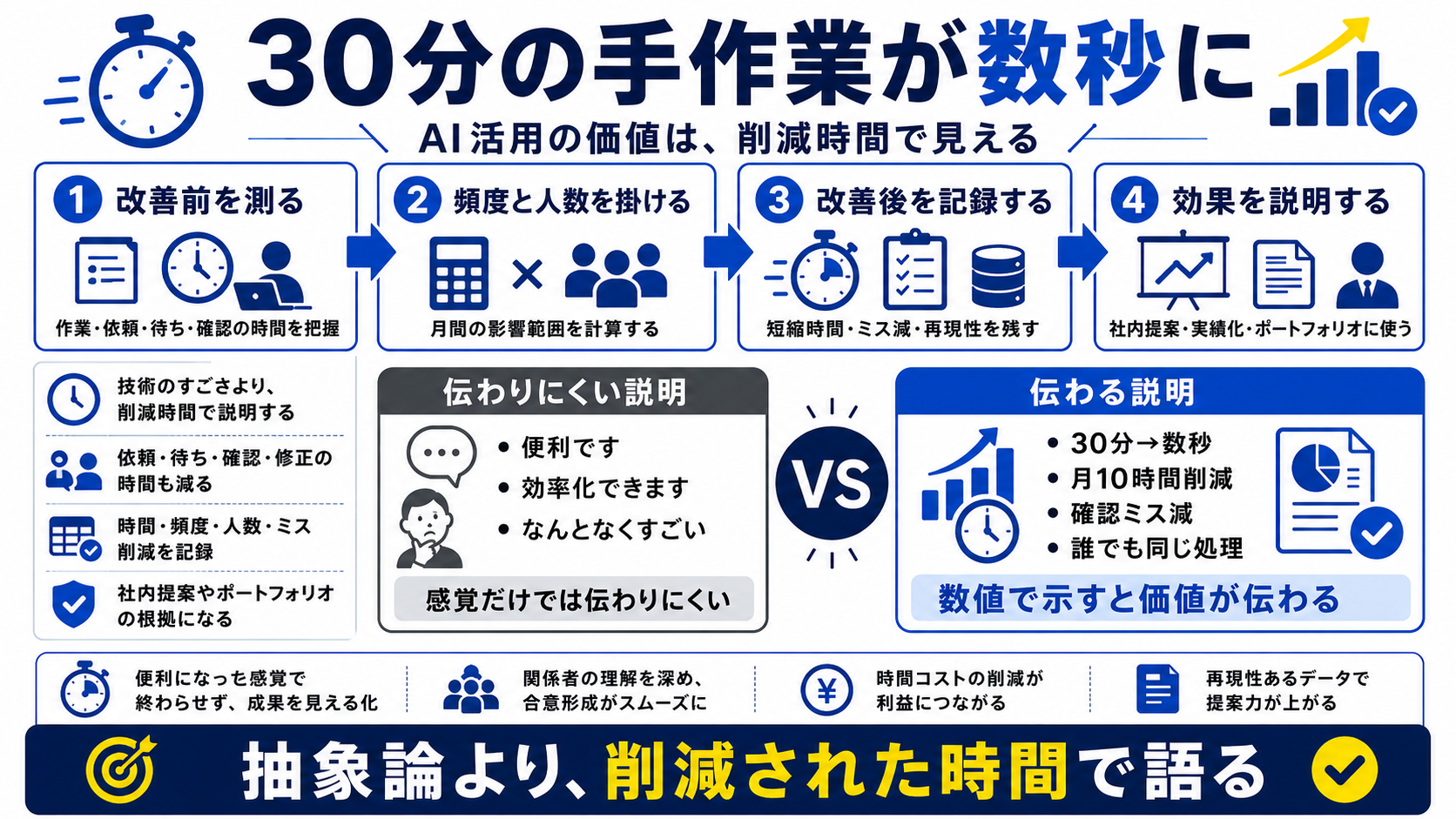
AI is easier to understand when explained through time saved
When explaining the value of AI or a tool, talking about technical sophistication may not get the point across.
But many people will understand if you explain that a task which used to take 30 minutes now takes seconds.
For operational improvement, the impact becomes clearer when you combine time saved, how often the task occurs, and how many people do it.
Even a 30-minute task adds up over a month if several people do it five times a week.
It reduces review and waiting time as well as hands-on work
AI can reduce more than the time spent doing the task itself.
It can also cut the time spent writing requests, waiting for someone, reviewing the result, and asking for revisions.
A task turned into a small tool can be run as soon as it is needed.
This immediacy is worth more than the time saved alone: it keeps work from getting stuck.
Visible results make people more open to using AI
Even cautious organizations can move forward when they see specific time savings.
Which task went from how many minutes to how many seconds? How much did errors fall? Who can use it? Does it communicate externally?
With these answers, AI use becomes a concrete operational improvement rather than a vague promise.
Concrete examples are especially persuasive when making the case internally.
Record the impact of the improvement
When AI makes a task faster, it is easy to get used to the convenience.
Then you may forget how long the task took before the improvement.
That is why you should record the time before and after, task frequency, number of users, and tasks eliminated.
These records can later support improvement results, a résumé, internal proposals, and a portfolio.
When 30 minutes of manual work becomes seconds,
the value of AI becomes visible without much explanation。
A different perspective on the same topic can change what you do
This is about changing how you view the work, not just making it faster. Separate the tasks people should handle from those that systems can take on to make practical decisions easier.
- AI makes things convenient
- It improves efficiency
- It makes work easier
- It uses the latest technology
- It is impressive somehow
- A 30-minute task now takes seconds
- It saves 10 hours a month
- Review errors have fallen
- Anyone can run the same process
- It works without external communication
A practical order for applying this idea
Turn the idea into steps for practical improvements, tool-building, and writing.
A checklist for applying the article’s ideas at work
Translate the ideas into practical checks so they do not end with reading.
Potential areas for improvement
- The original task time is known
- Task frequency is known
- The new task time can be measured
- The number of users is known
- The time savings can be explained
Failure patterns to avoid
- Relying only on a sense that it feels easier
- Failing to record the original time
- Looking only at time saved, not quality
- Not explaining safety or operational requirements