Work That Needs Expertise and
Work That Can Be Turned into a Tool
When we cannot do a task, we tend to assume that it requires specialized expertise.
In many cases, however, the task does not require expert judgment; it simply lacks a dedicated tool or suitable working environment.
Confusing the two creates unnecessary requests, waiting, and review costs.
In the AI era, separating expertise from missing tools is an important way to improve work.
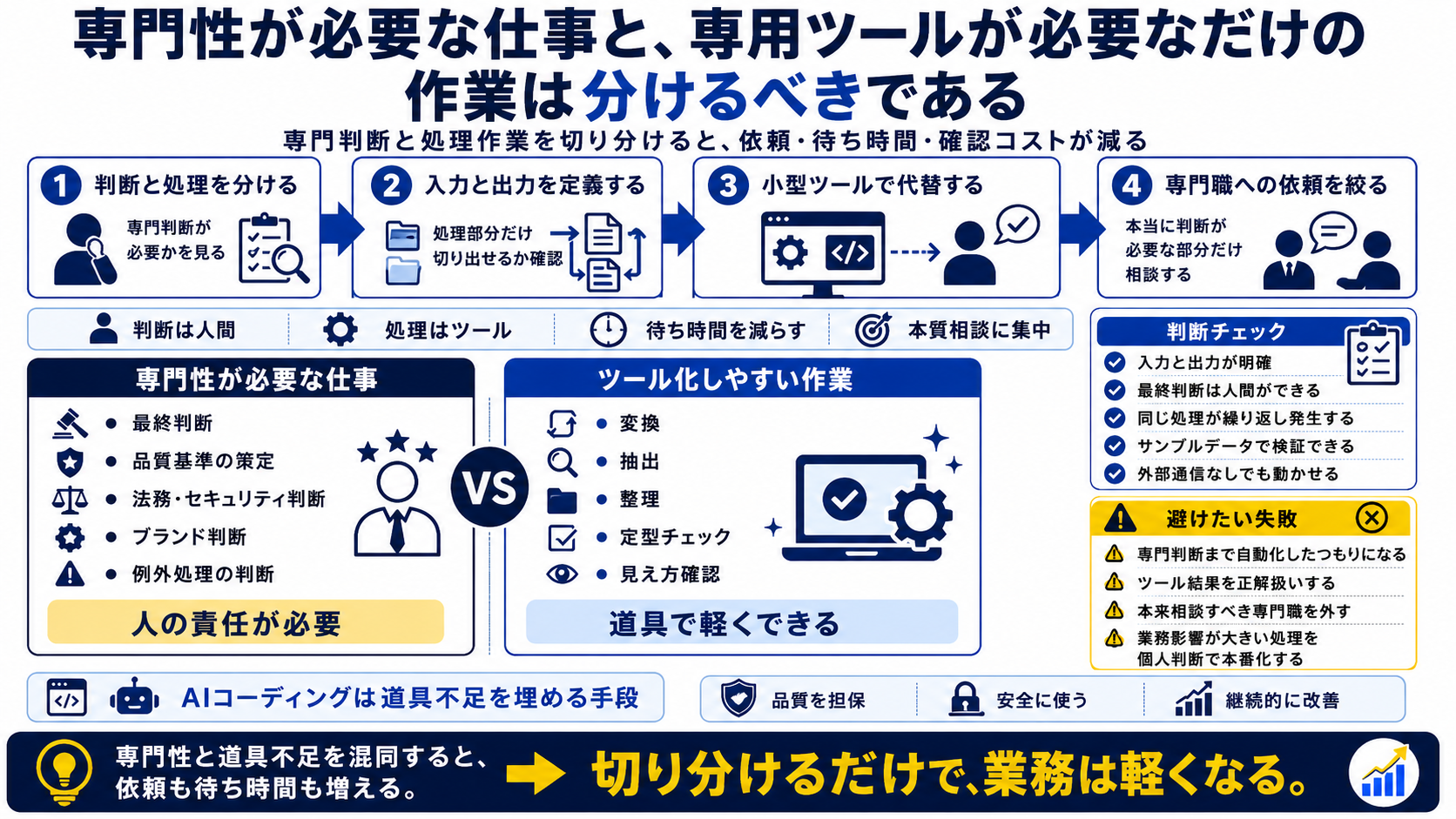
Some work needs an expert; other tasks just need the right tool
Some work clearly requires specialist knowledge and accountability, such as design, legal, brand, security, and system-design decisions.
Other tasks—exporting images, converting formats, creating lists, checking dimensions, or organizing files—may be manageable on your own with a dedicated tool.
If both are treated as “specialist work,” professionals end up receiving requests that could have been handled without them.
As a result, specialists have less time for the judgment and design work that needs their attention.
AI coding can help fill the tool gap
AI coding has lowered the barrier to building simple helper tools.
For tasks such as standardizing filenames, extracting text, converting CSV files, checking how an image appears, or catching input errors, a small HTML or JavaScript tool may be enough.
These tools do not need to be perfect products. They only need to make a specific task easier for you or your team.
When AI helps fill a tooling gap, requests to specialists can focus on more substantive questions.
Do not delegate expert judgment to a tool
The key is to avoid assuming that automating a process also automates the judgment around it.
A tool can check image dimensions, but deciding whether the image fits the brand is a separate judgment.
A tool can detect differences in a CSV, but a person still needs to decide whether those differences matter to the work.
Building tools with AI does not eliminate specialists; it helps them focus on the expert judgments that require their skills.
Set criteria for separating the work
When examining a task, first separate judgment from processing.
Judgment depends on human accountability, experience, and context. Processing has clear inputs and outputs and can often be turned into a procedure.
Processing is the part that AI and tools can more easily take over.
This distinction helps avoid both over-automation and unnecessary requests.
Work that needs expertise and
tasks that only need a dedicated toolshould be separated.
A different perspective on the same topic can change what you do
The question is not simply whether to use AI. Decide which tasks to keep, which to reduce, and which decisions should remain with people.
- Final decisions
- Setting quality standards
- Legal and security decisions
- Brand decisions
- Handling exceptions
- Conversion
- Extraction
- Organization
- Routine checks
- Visual checks
A practical order for applying this idea
Turn the idea into steps that can be applied to real operational improvement.
A checklist for applying the article’s ideas at work
Translate the ideas into practical checks so they do not end with reading.
Potential areas for improvement
- Inputs and outputs are clear
- People can make the final decision
- The same process recurs
- It can be tested with sample data
- It can run without external communication
Failure patterns to avoid
- Assuming expert judgment has been automated
- Treating a tool’s result as unquestionably correct
- Excluding specialists who should be consulted
- Putting a high-impact process into production based on one person’s judgment