Organizations That Reward Busyness Won’t Grow in the AI Era
People who work long hours, always look busy, or handle large volumes of small tasks are often rewarded in organizations.
But in the AI era, organizations that define diligence only as endurance for routine work are less likely to grow.
That is because the most valuable improvements often reduce the amount of work.
When busyness is rewarded, people who reduce work become harder to recognize.
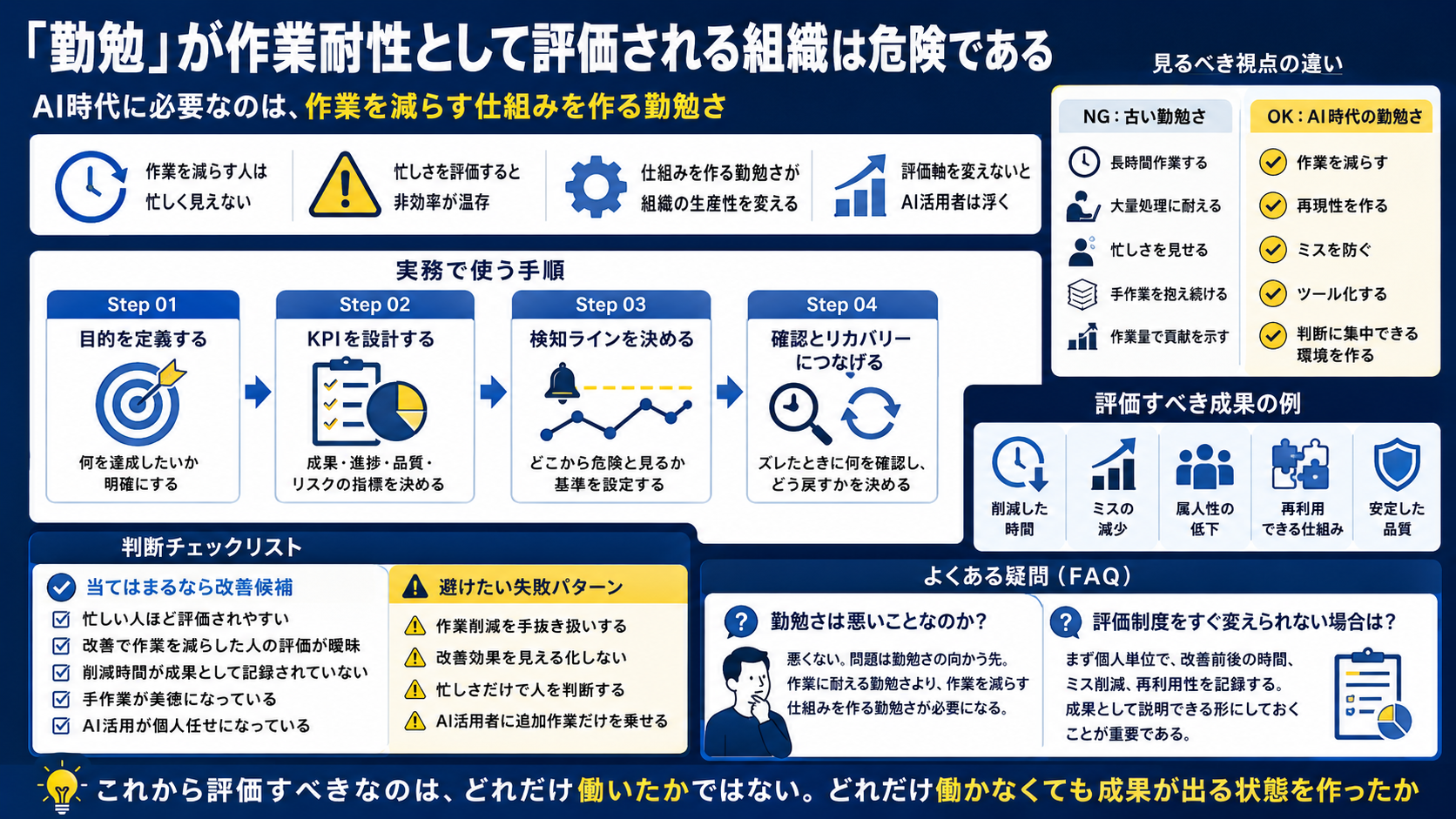
Rewarding busyness hides the people who reduce work
People who work long hours, have a full calendar, or take on large amounts of detailed processing are often seen as “working hard.”
But busyness is not the same as results. Looking busy may signal that work has not been reduced or systematized, or that too much of it still depends on individuals.
Someone who uses AI or a small tool to cut a 30-minute task down to seconds may not look busy. Someone who spends 30 minutes on that same task every time does.
If busyness is the measure, an organization rewards people who keep carrying tasks instead of those who reduce them. That is a serious loss in the AI era.
Rewarding task endurance keeps the tasks in place
Diligence has traditionally been associated with working long hours, handling high volumes, and enduring tedious tasks.
Persistence and a sense of responsibility still matter. The problem is when this definition of diligence discourages people from reducing work.
If people are rewarded for continuing to carry the same tasks, systematization and automation will stall. Those who improve the process end up with less work, making their contribution less visible.
As a result, organizations stay dependent on manual processing. Where task endurance is treated as a virtue, AI adoption can become just another convenient task.
Diligence should now mean building systems that reduce work
In the AI era, diligence should mean creating a state where people no longer have to repeat the same work, rather than simply working longer.
Prevent the same mistakes from recurring. Make the process accessible to anyone. Standardize checks. Use AI or tools to reduce preprocessing.
These improvements may look modest. But once systematized, they make work easier not only for the person who built them but for everyone around them.
The effort should shift from doing the tasks to improving the system. The value of AI is not only in completing work faster; it is also in reducing the work itself.
Without a new measure, people who use AI well can be marginalized
People who use AI well try to reduce the tasks themselves. They break down procedures, create templates, automate checks, and reduce rework.
In organizations with outdated measures, this can look like cutting corners. The faster someone finishes the task, the less hardworking they may appear.
In reality, the results are time saved, fewer errors, less reliance on individuals, and systems that can be reused.
If leaders cannot see these results, AI use remains an individual effort and does not spread across the organization. To recognize people who use AI well, measure the work they eliminate rather than the volume they handle.
The direction of diligence shapes an organization’s future
What matters is not how much work someone endured, but how much they shortened the path to results and prevented the same burden from recurring.
- Working long hours
- Enduring large workloads
- Appearing busy
- Keeping manual tasks
- Showing contribution through workload
- Reducing tasks
- Creating repeatable processes
- Preventing errors
- Building tools
- Creating room for better decisions
Make improvements visible before changing the evaluation system
Even if you cannot immediately change the evaluation system, you can change how improvements are recorded. First make visible what has been reduced and what can be reused before rewarding busyness.
Signs the organization may overvalue task endurance
Use these signs to assess whether AI adoption and operational improvement are getting stuck as individual efforts.
Potential areas for improvement
- Busier people are more likely to be rewarded
- The contributions of people who reduce tasks are unclear
- Time saved is not recorded as a result
- Manual work is treated as a virtue
- AI use is left to individuals
Failure patterns to avoid
- Treating task reduction as cutting corners
- Failing to make improvements visible
- Judging people by busyness alone
- Adding work to people who use AI without recognizing the savings
Keep the diligence; change its direction
A risky organization in the AI era is one that
rewards busy people and overlooks those who reduce work.