Faithful Porting with Codex Starts with a Frozen Specification
There is an important risk when asking AI to port an existing tool.
Even when you only want a faithful port, AI may interpret the request as including improvements or a redesign.
That can change the original functionality or appearance.
For a faithful port, freeze the specification before work begins.
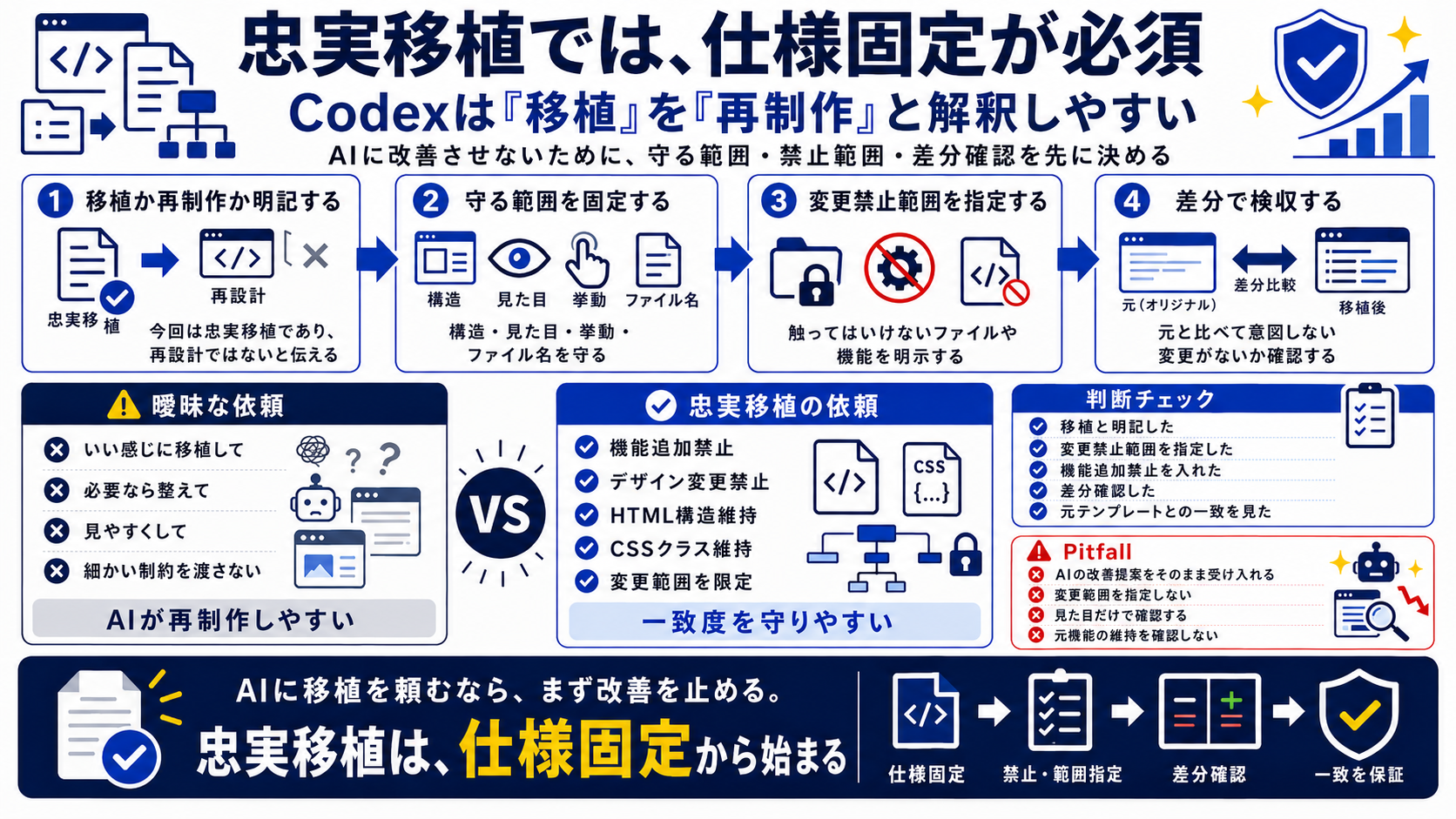
AI May Try to Improve Things
AI may try to make things better instead of simply copying them.
It may polish the UI, change the structure, add features, or remove parts that seem unnecessary.
In regular development, that can be helpful.
In a faithful port, however, that helpfulness can be risky.
Porting Is Different from Rebuilding
Porting means moving something to a different environment or format while preserving its existing functionality, structure, appearance, and behavior as closely as possible.
Rebuilding means creating something new from the original purpose.
If the distinction is unclear, AI may treat a porting task as a rebuild.
Take particular care when preserving an existing template, design, or UX.
Define What Can and Cannot Change
When requesting work from AI, clearly state what may change and what must stay untouched.
Keep the HTML structure and CSS classes; replace copy only; add no features; make no design changes; leave existing JavaScript untouched.
Writing these constraints down helps prevent unnecessary changes.
It may be safer to protect source-of-truth files, such as AGENTS.md and template files.
Review the Diff
For a faithful port, review the diff against the original file instead of looking only at the finished result.
Check that appearance, file structure, navigation, metadata, CSS, JavaScript, and content volume have not changed unintentionally.
AI output may look polished and still fail to meet the original requirements.
In faithful porting, fidelity matters more than polish.
For a faithful port,
Freeze the specification so AI does not improve the design is essential.
A Different Perspective Can Change What You Do
This is about changing how the work itself is approached, not just making it faster. Separating what people should handle from what can be systematized makes practical decisions easier.
- Port it and make it look good
- Tidy it up if needed
- Make it easier to read
- Make it the same
- No detailed constraints provided
- No feature additions
- No design changes
- Keep CSS classes
- Keep the HTML structure
- Limit the scope of changes
A Practical Sequence
Use this sequence to apply the idea to process improvements, tools, or articles.
Checklist for Applying the Idea at Work
Turn the article into checks that can be used in day-to-day work.
Signs there may be room to improve
- The request says “port,” not “rebuild”
- Protected areas are listed
- The request prohibits feature additions
- The diff has been reviewed
- The result has been checked against the original template
Failure patterns to avoid
- Accepting AI’s improvement suggestions without review
- Leaving the change scope undefined
- Checking appearance only
- Failing to check that original functionality remains intact