AI Development Quality Depends on Clear Roles
In AI development, writing good prompts is not the only factor.
The way work is assigned also has a major impact on quality.
Some AI systems are better at implementation, others at review, organizing prose, or auditing.
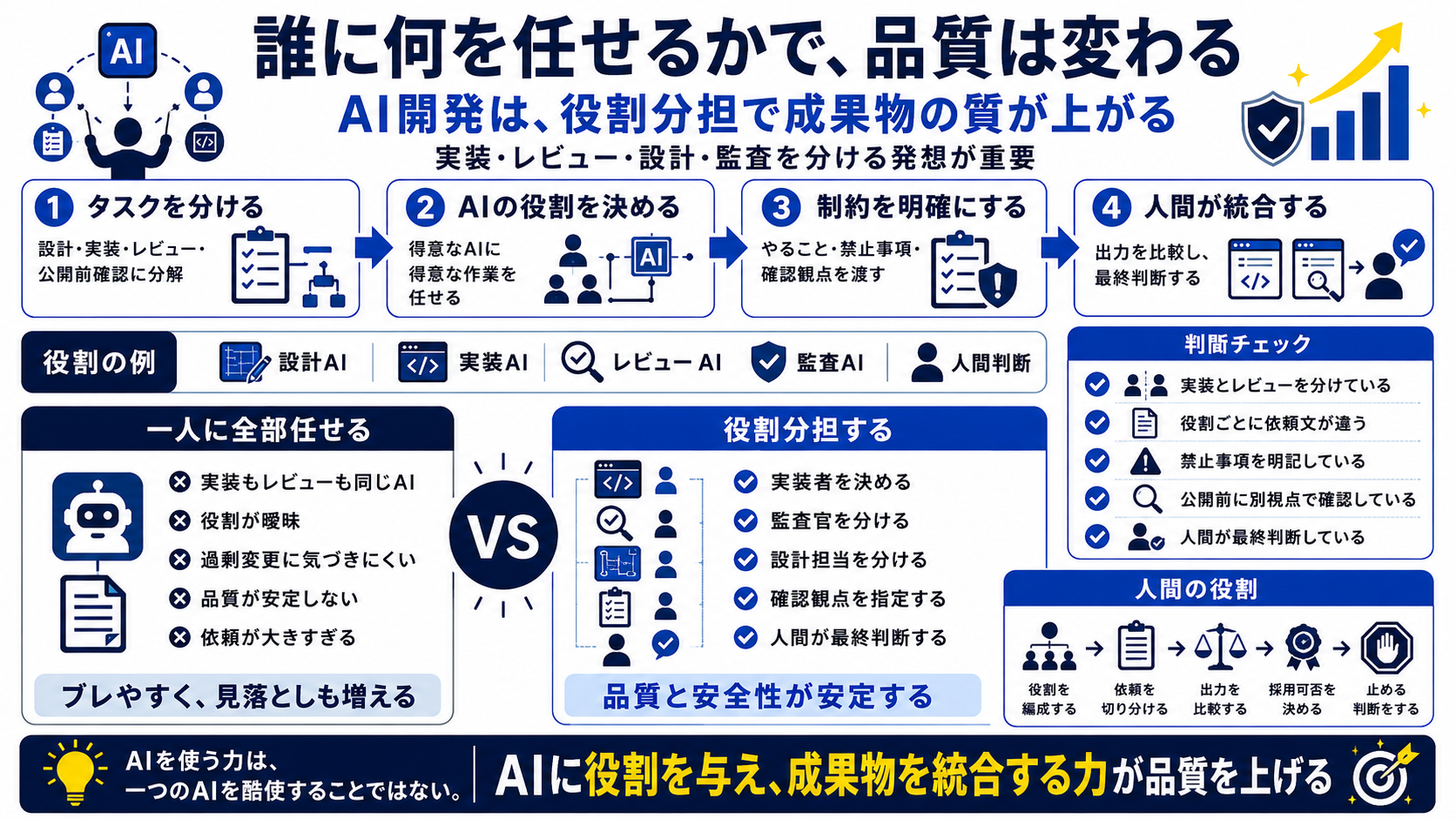
Work is often more reliable when AI is assigned distinct roles instead of being treated as one all-purpose worker.
AI Has Strengths and Weaknesses
Different AI systems produce different results, even when given the same request.
One AI may implement quickly but make overly broad changes; another may review carefully but implement more slowly.
Some systems are better at structuring prose, inspecting code diffs, or reviewing designs.
Ignoring these differences and delegating every task the same way makes results less consistent.
Separate Implementation from Auditing
Human development teams sometimes separate implementers from reviewers.
The same approach works in AI development.
Having one AI implement and another review makes it easier to catch omissions and excessive changes.
A separate AI auditor is especially useful for protecting existing files and checking work before publication.
Clear Roles Make Requests More Precise
It is easier to make a request when the scope is specific: implement this, review that, or organize the requirements—rather than asking AI to do everything.
Clear roles also make it less likely that AI will make unrelated changes.
It becomes easier to set constraints such as no feature additions, preserve the structure, inspect diffs only, or review SEO only.
In quality control, defining what not to do is as important as defining what to do.
People Become Directors of the AI Team
As AI development advances, people need to do less of the hands-on work themselves.
People still decide which AI handles each task, which outputs to accept, and when work should stop.
That responsibility is similar to a director’s role.
To get the most from AI, think beyond using a tool and start building a team of systems with complementary roles.
In AI development,
Who does whatcan make all the difference to quality.
A Different Perspective Can Change What You Do
This is about more than efficiency; it changes how the work itself is viewed. Separating what people should handle from what can be systematized makes practical decisions easier.
- One AI handles both implementation and review
- Roles are unclear
- Excessive changes are easy to miss
- Quality is inconsistent
- Requests are too broad
- Assign an implementer
- Assign a separate auditor
- Assign a design reviewer
- Specify what to check
- Keep the final decision with a person
A Practical Sequence for Applying This Idea
Use this sequence to move from the idea to practical improvements, tools, or articles.
Checklist for Applying the Idea at Work
Turn the article into concrete checks that can be used in day-to-day work.
Signs there may be room to improve
- Implementation and review are assigned separately
- Requests differ by role
- Prohibitions are explicit
- A different perspective reviews work before publication
- A person makes the final decision
Failure patterns to avoid
- Treating AI as an all-purpose worker
- Publishing without review
- Combining roles
- Using outputs without integrating them