AI gets stronger with use.
From One-Off Generation to Compounding Knowledge
The value of AI is not limited to producing a piece of writing faster. Capture a question that arose in conversation as an observation, turn an implementation failure into a decision criterion, turn an article into a public asset, and feed the learning into the next AI task. This cycle makes AI more than a convenient tool: it becomes a system that compounds your knowledge with use.
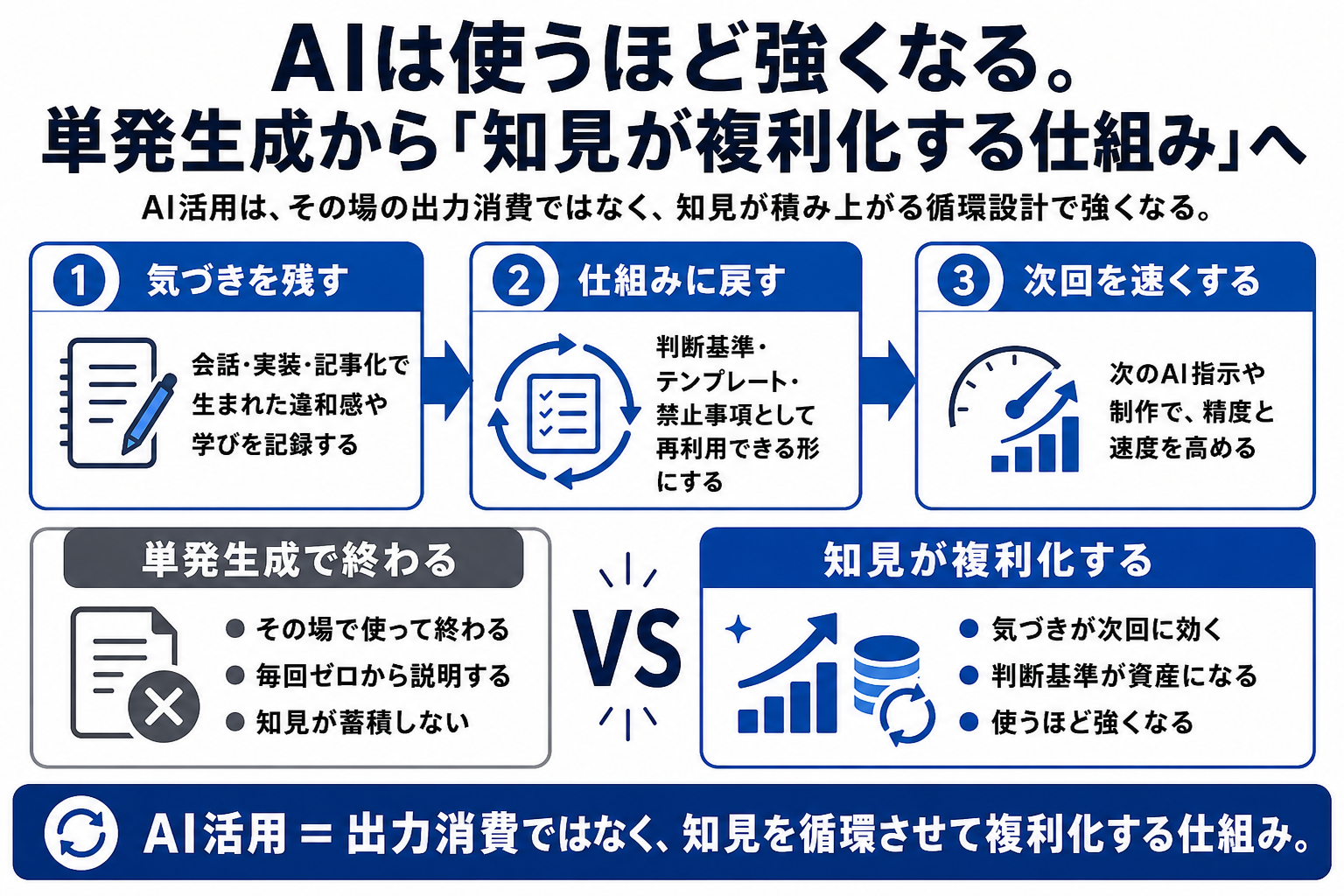
Measure AI by what carries over to future work, not just by its immediate output
Many AI workflows end with one answer to one question. That can still save time on research or writing, but most of the value disappears once the output is used. Next time, you explain the same things, provide the same context, and correct the same kinds of errors all over again.
With a compounding AI workflow, you do not consume an output and move on. Preserve good decisions, failed instructions, useful wording, and reusable structures. Then you do not have to start from scratch in the next conversation. As your input assets grow alongside the AI's capabilities, you can reach a higher level in the same amount of time.
What matters is not how often you use AI, but whether each conversation leaves behind reusable knowledge. Time spent becomes a log; the log becomes decision criteria; those criteria speed up the next deliverable. Once this cycle is in place, AI use becomes accumulation instead of consumption.
One-off use
- Ask a question and stop
- Use up the answer
- Leave no knowledge behind
Build up knowledge
- Record decisions
- Apply past failures next time
- Turn conversations into assets
People who become more effective with AI do not just save its answers.
Decision criteria from one answer feed into the next AI task.
Connect conversations, summaries, implementation, articles, and database entries in one flow
Compounding value requires keeping AI conversations connected. An insight from an informal discussion, a reason an implementation got stuck, or a decision made while writing an article can all be reused. Treat them as separate events and their value gets scattered.
Suppose you are writing an article. Along the way, you may decide that a topic is too thin, a certain angle is stronger, or a particular template is more reliable. Save those decisions in an insights database and use them when selecting the next topic. When Codex implements the article, add successful instructions and prohibitions back to the template.
This loop is more than a way to save time. It is like developing a personal operating system for making things. The AI itself may not become smarter, but it receives better context and decision material. As a result, the quality and speed of its output improve over time, even with the same AI.
- Keep conversations isolated
- Let insights disappear
- Explain everything again each time
- Save insights in a database
- Turn them into decision criteria
- Feed them into the next task
Measure AI's ROI by the assets it creates as well as the time it saves
When evaluating AI's return, it is tempting to focus only on the hours saved. That is easy to measure, but incomplete. A compounding AI workflow also creates assets: decision criteria, articles, templates, prompts, operating rules, and implementation processes.
On a short-term profit-and-loss statement, an AI subscription looks like a cost. On a personal balance sheet, it may be building intellectual assets. Systems that generate future deliverables—such as an insights database or an article workflow—can be more valuable than a one-off answer.
This perspective changes how you evaluate AI. Minimizing cost is not the only goal; what matters is which parts of the work can become assets. If each use adds to the log, the log improves decisions, and those decisions create the next deliverable, the expense is part of your production environment—not just a subscription fee.
Build a path for knowledge to flow back before trying to perfect your prompts
You do not need a large system to get started. First capture observations from conversations at a level of detail that makes them reusable. Then decide whether to turn them into article ideas, decision criteria, work instructions, or Codex prompts.
The key is not to create more places to store information, but to create a path back to it. A note is not an asset if no one consults it in the next task. Check the insights database when planning an article, review past prohibitions when asking Codex for work, and revisit prior conclusions when a decision is difficult. A database becomes useful when it is connected to the moments when you need it.
Mature AI use is not about getting an impressive result in one shot. It is about capturing small insights, feeding them into the next instruction, and turning them into deliverables. Once this loop is running, AI shifts from a one-off answer engine to a foundation that amplifies an individual's intellectual work.
Distinguish weak practices from strong ones
The important question is not the surface-level task name, but what to preserve and what to turn into something reusable.
Weak practices
- Stop at a one-off answer
- Keep no record
- Measure only time saved
Strong practices
- Accumulate decision criteria
- Use a database to develop articles
- Turn spending into assets
What sets AI use apart is not the speed of an answer, but what remains after it.
What sets AI use apart is not the speed of an answer, but what remains after it. Once you move beyond one-off generation and build a cycle that feeds knowledge back into future work, AI becomes a compounding system that amplifies your capabilities.
- AI becomes a compounding system that builds knowledge with every use
- An insights database is an article engine, not merely a list of ideas
- The value of AI is in building a knowledge loop, not generating one-off answers
- An investment may not pay back immediately but can still build assets on a personal balance sheet