AI agent development as practical-skills training
Building small tools with AI agents or Codex is about more than producing an artifact.
It lets you work through requirements, design, review, UX, security, operations, acceptance testing, and improvement in short cycles.
It is much like a training machine for broad practical skills.
Because AI helps with implementation, people need stronger design and acceptance-testing skills.
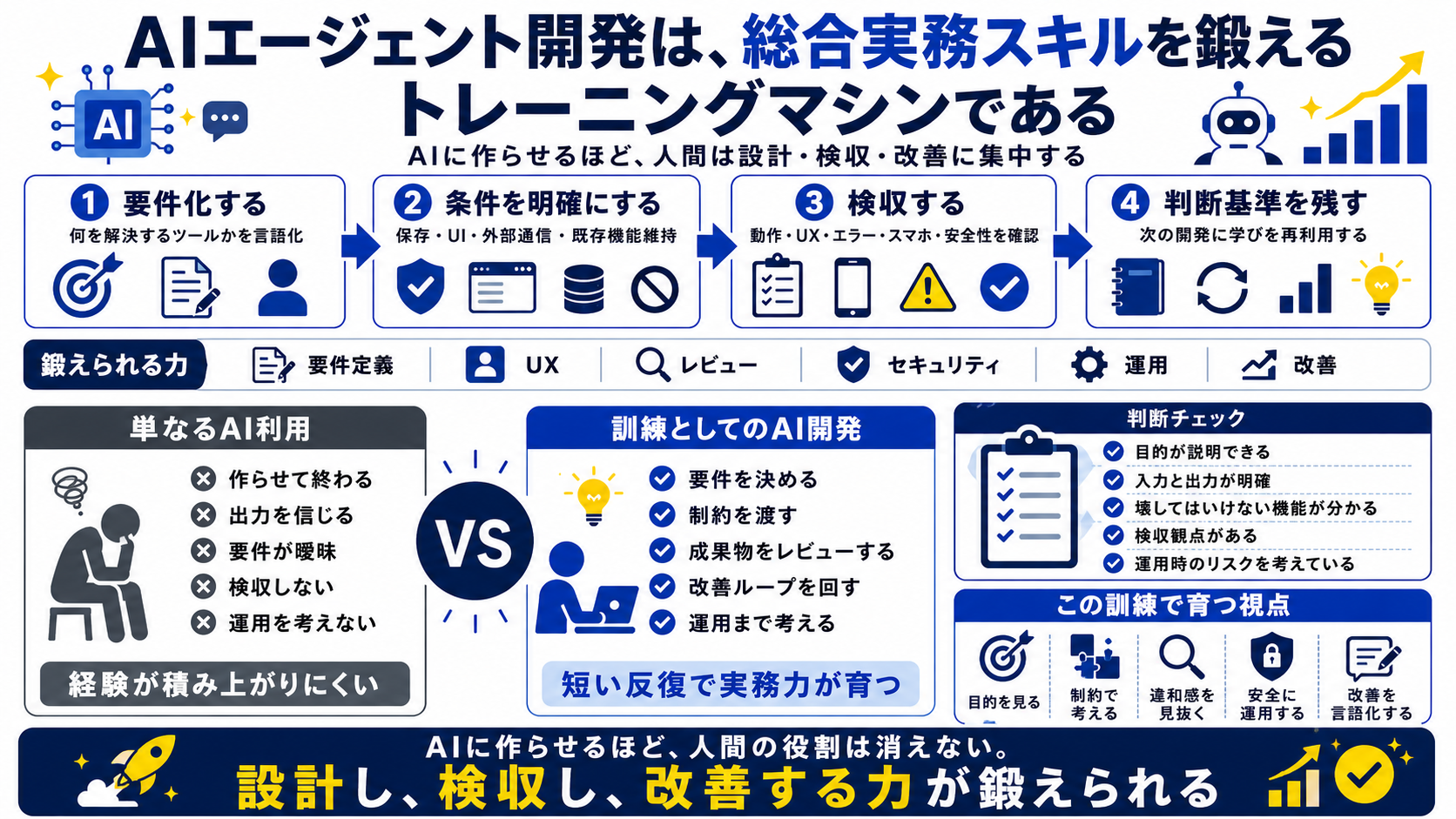
AI development can become a compressed training ground for practical skills
Even a small tool requires careful thought.
What is its purpose? Who will use it? What goes in and what comes out? How should errors be handled? Is storage needed? Will it communicate externally? Must it work on a phone?
These are exactly the questions that matter in product development and operational improvement.
AI writing the code does not make the human role disappear. Instead, people can focus on upstream decisions and acceptance testing.
Building tools sharpens your eye for requirements
Vague requests to AI produce vague results.
You need to spell out what you want to build, what must not break, and which constraints must be respected.
That is requirements definition.
The more small tools you build, the more naturally you consider purpose, constraints, exceptions, and acceptance criteria.
Acceptance testing becomes stronger
What AI builds may look polished at first glance.
But real use can reveal unclear buttons, weak error messages, broken mobile layouts, missing save paths, or overlooked security assumptions.
The ability to spot these issues is acceptance-testing skill.
AI development is not about receiving a finished product; it is about shaping AI output into something usable in practice.
Operations and governance matter too
AI agents and tools are not finished when they are built.
Who will use it? How will it be explained? How much should be automated? Will it keep logs? Can it be stopped if it malfunctions?
The closer a tool gets to real work, the more operations, monitoring, and governance matter alongside convenience.
With this perspective, AI development becomes practical-skills training rather than just experimentation.
AI agent development is
a training machine for broad practical skillsis.
A different perspective on the same topic can change what you do
The question is not simply whether to use AI. Decide which tasks to keep, which to reduce, and which decisions should remain with people.
- Letting AI build it and stopping there
- Trusting the output
- Leaving requirements vague
- Skipping acceptance testing
- Ignoring operations
- Defining requirements
- Providing constraints
- Reviewing the result
- Running an improvement loop
- Planning for operations
A practical order for applying this idea
Turn the idea into steps you can use in real operational improvement.
A checklist for applying the article’s ideas at work
Translate the ideas into practical checks so they do not end with reading.
Potential areas for improvement
- The purpose can be explained
- Inputs and outputs are clear
- Features that must not break are identified
- Acceptance criteria are defined
- Operational risks have been considered
Failure patterns to avoid
- Handing everything to AI
- Calling it done based on appearance alone
- Failing to check error handling
- Ignoring operations after launch