The Entry Point for Using AI
Is Not Prompts.
It Is Work Decomposition.
AI adoption is often discussed through prompt writing. But in actual work, the first need is to decompose the job and identify where AI can be inserted.
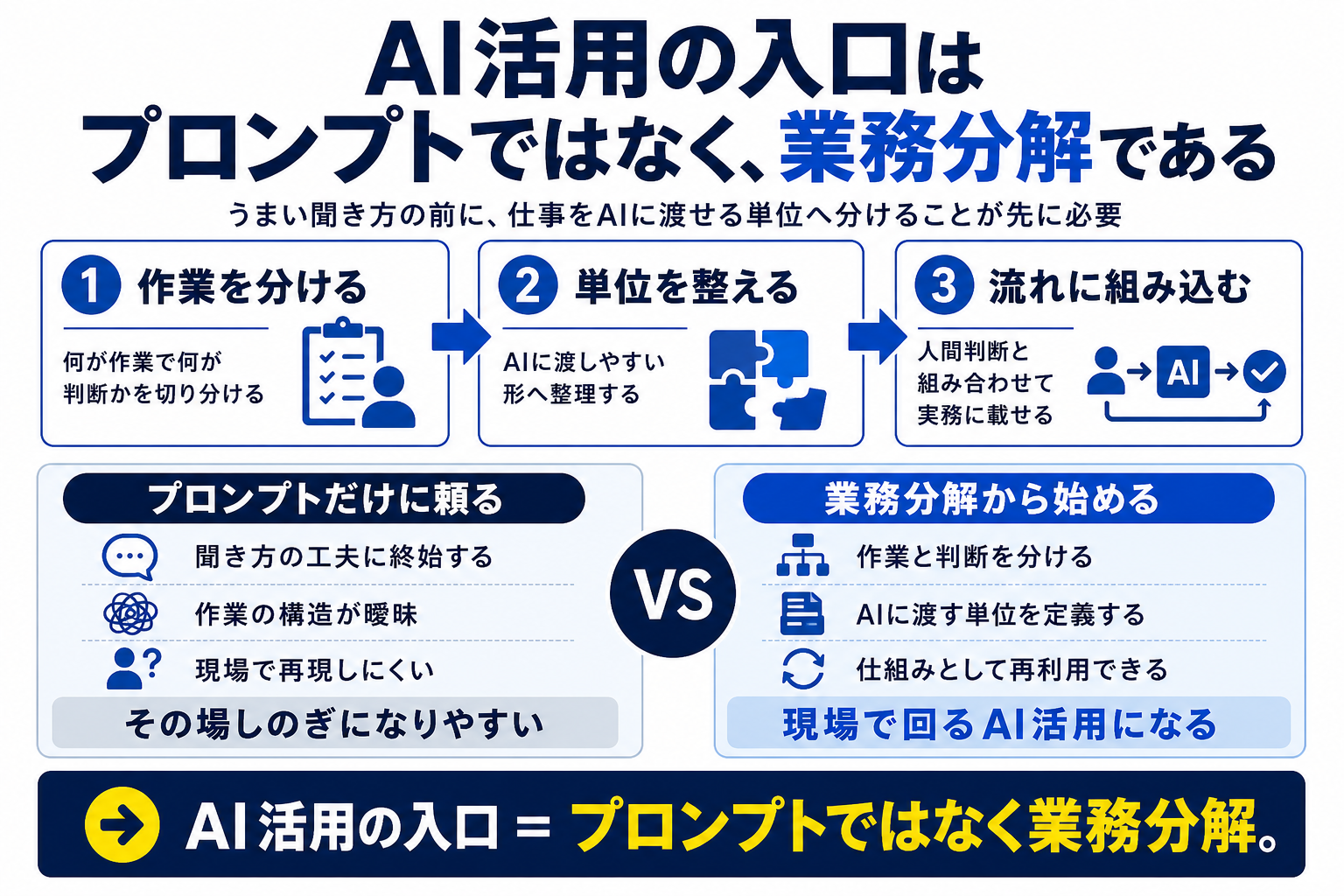
What should be taught first is not prompt wording. It is the ability to divide work into task units.
The reason people cannot use AI is not only a lack of prompts
AI can be introduced and still remain unused in the field. If the cause is reduced to not knowing prompts, the countermeasure will be wrong. Often, people cannot see where AI fits inside their own work.
Daily work mixes judgment, checking, transcription, formatting, summarization, communication, and exception handling. As long as all of that is seen as one job, it is hard to find units that can be handed to AI.
Start from prompts
- Measure by task speed
- Hold all work yourself
- Have humans check everything
Decompose the work
- Separate task units
- Separate judgment points
- Shape work so AI can receive it
Separate work, tasks, judgments, and exceptions
When decomposing work, start with four buckets: judgments humans remain responsible for, repeated tasks, checks that must be performed, and exception handling. This alone makes the parts suitable for AI much easier to see.
For email, humans can confirm facts, AI can draft, and humans can send. For meeting minutes, AI can transcribe and summarize, while humans confirm important decisions. Not everything needs to be automated.
Look at reduced work, not AI usage count
Internal AI promotion often tracks how many times AI was used. But usage count alone does not prove improvement. What matters is reduced work, fewer checks, shorter processing time, and fewer rework loops.
If AI use increases rework, it is not improvement. If usage is modest but repetitive work is clearly reduced, there is value.
Start with small, frequent work with a fixed output format
Trying to automate a large process first is risky. Start with recurring reports, email drafts, FAQ organization, meeting summaries, and data formatting.
Good candidates have three traits: high frequency, clear input and output, and explainable judgment criteria. These are the tasks that fit AI well.
Separate weak use from strong use
The point is not to start internal AI adoption from prompt education. It is to decompose work into jobs, tasks, and exception handling, then identify the parts that can actually be reduced.
Weak use
- Only learn prompts
- Do not separate tasks
- Use AI as a vague handoff
Strong use
- Decompose work
- Separate tasks from judgment
- Find work that can be compressed
AI adoption starts by decomposing work
Before learning prompts, people need to separate the tasks, judgments, checks, and exceptions that make up their work. Only after decomposition can they safely divide what AI handles and what humans keep.
- The reason people cannot use AI is not only a lack of AI skill
- AI adoption goals should be designed as work decomposition goals
- What looks like a full day of work may compress into a few hours when decomposed