Present Japanese crafts
Choose by Meaning.
When people overseas choose a Japanese craft as a gift, they may not start with a product name or category. They may begin with a wish: to celebrate a marriage, wish someone a lasting bond, or express peace. I built an experience that leads from that intention to a craft item in two days, handling planning, UX and UI design, image creation, development, and deployment on my own.
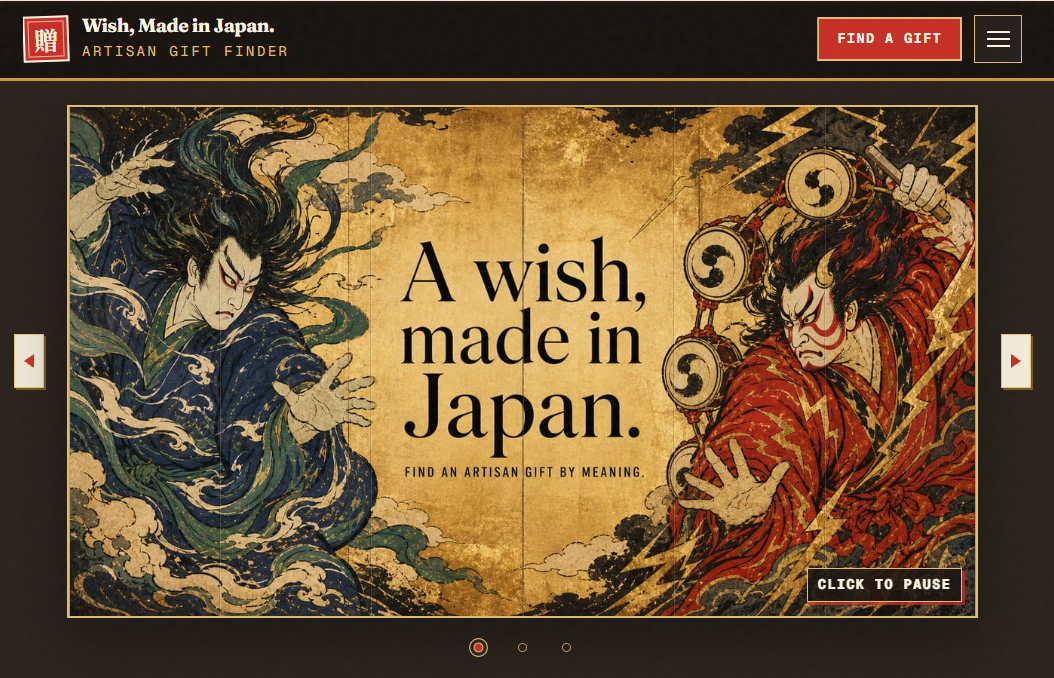
Start with “what you want to convey,”
rather than “what to give.”
For gift givers overseas who are not familiar with Japanese culture, the meaning of motifs such as cranes, shippo patterns, and seigaiha waves may not be obvious. Instead of starting with product categories, I made a gift finder the core experience. It narrows down options based on three things: the occasion, the wish to send, and the budget.
For a wedding gift, a shopper might choose “A lasting bond”; for a housewarming, “A new beginning.” They first select the meaning they want to express in English. Japanese motifs appear afterward as the cultural basis for that choice. This information design makes culture a reason for choosing, rather than mere decoration.
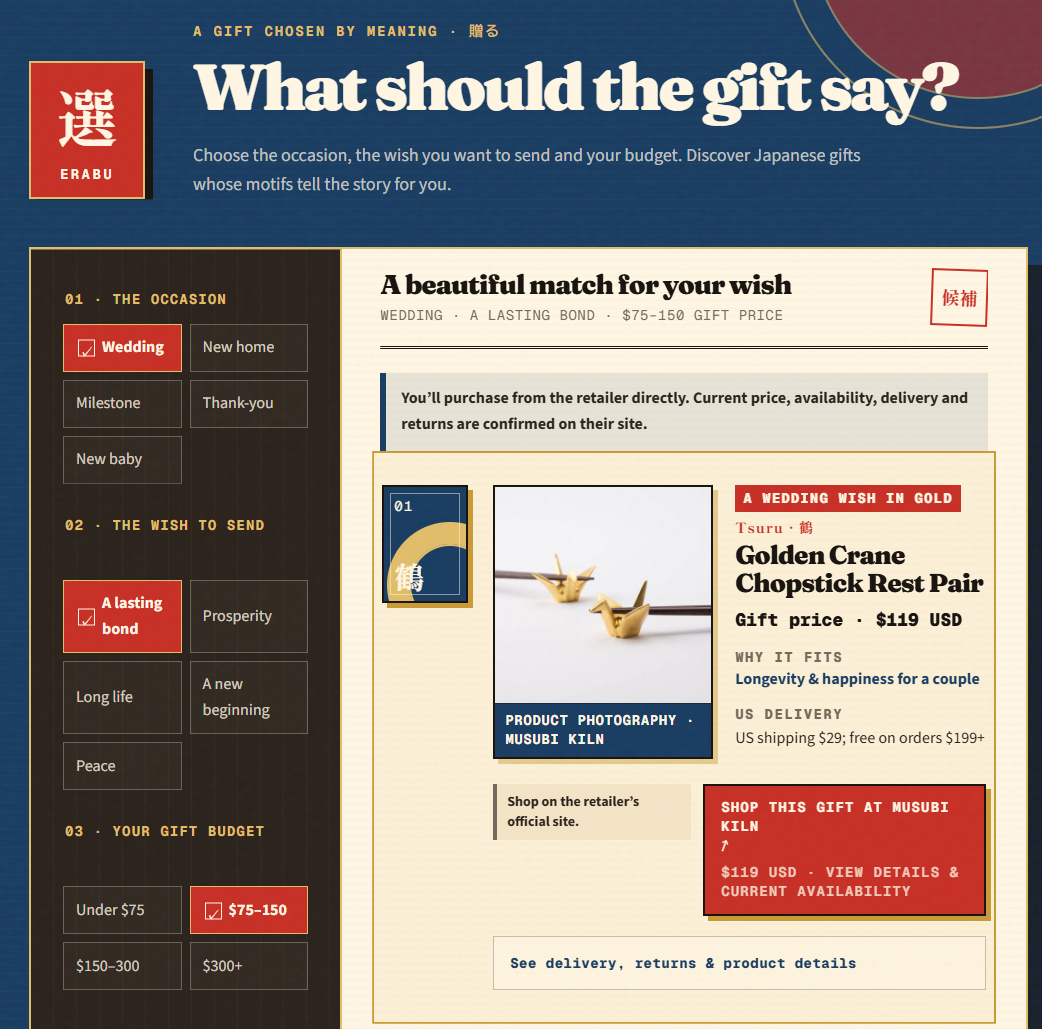
The goal is not simply to present something as Japanese for an overseas audience.
Let Japanese craft carry the feeling you want to share.
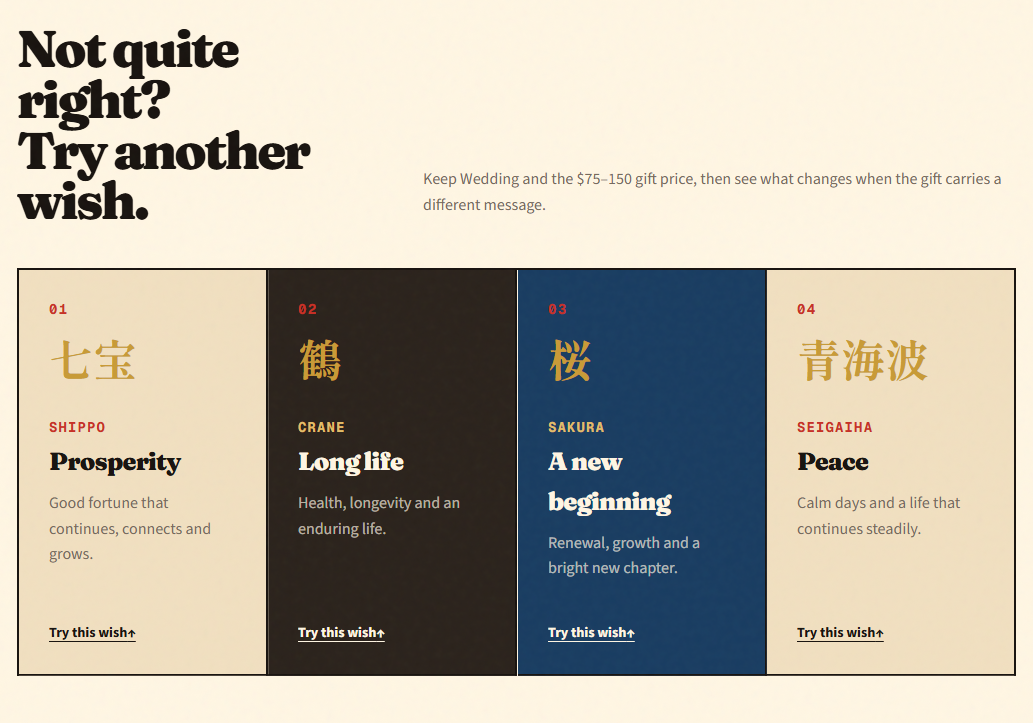
Instead of returning to the product list,
visitors can change the wish and choose again.
When the first suggestions do not feel right, a typical online store often sends shoppers back to the product list. Here, they can keep the wedding occasion and budget while changing only the wish: prosperity, longevity, a new beginning, or peace. The question to reconsider is not which product to buy, but what they want to express to the recipient.
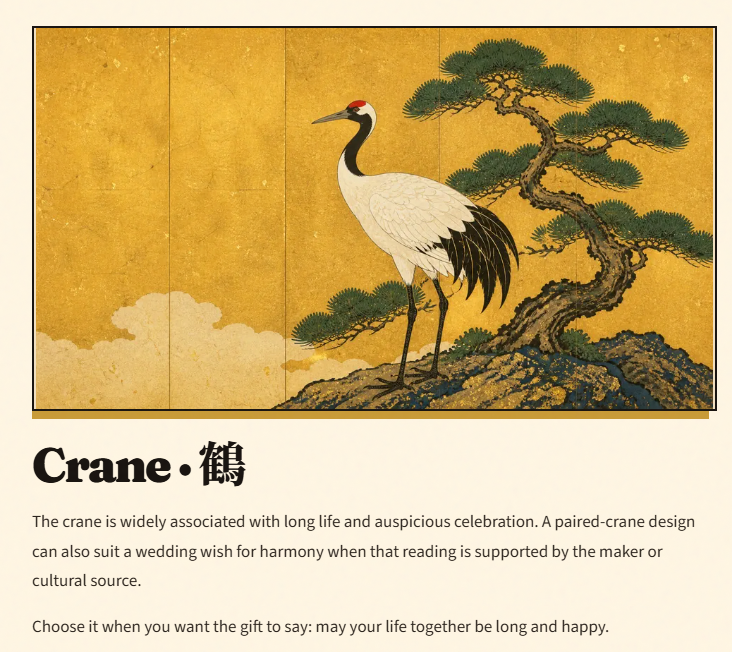
Do not give AI a generic brief.
Start by giving it a distinctive creative world.
If I had only asked AI to make a Japanese product site for overseas shoppers, the result could easily have leaned toward a generic Japanese-style shop. Instead, I started with a concept rooted in a bold Edo visual culture that blended cues from Hokusai, Sharaku, and the Kano school. Strong contrasts of black, gold, vermilion, and indigo, along with compositions recalling prints and folding screens, became the design criteria for the whole site.
When I make the concept distinctive from the beginning, AI is less likely to fall back on an average solution and instead tries to meet the brief. People decide not only what AI should make, but also the world in which it should solve the problem. That is where originality begins.
- “Introduce Japanese products to an international audience”
- Likely to resemble a typical Japanese-style online shop
- Distinctiveness stays on the surface of the UI
- Translate the bold visual culture of Edo
- Align decisions about color, composition, copy, and user flow
- Give AI room to develop ideas within clear constraints
Keep cultural meaning and purchase decisions
side by side, without conflating them.
The explanations of meaning are not stories designed to pressure people into buying. I separated information about the motifs, suitable occasions, how products are selected, and where to check price, stock, shipping, and returns, so shoppers can make their own decisions. Purchases lead to the official sellers, where shoppers can confirm current details.
AI made production faster, but I did not rely on it as evidence for cultural meanings or product information. People verify the site before publication and make editorial decisions by returning to primary sources. This division of work helps balance speed with trust.
Connect the process from planning to release
as one cohesive experience.
Bring together the target audience, a flow that starts with the meaning of the gift, the Edo-inspired visual world, and the direction for the English copy.
Complete the screens, conditional flows, content placement, display checks, and deployment using the same design criteria.
Wish, Made in Japan. — Sources for screenshots and the experience discussed in this article.