Is AI Subscription Spending
Waste or Investment?
Recovery Design for Individual Producers
When you pay for AI every month, the amount can look expensive if you only read the bill. But if article creation, research, summarization, design, development, and learning keep moving because of it, the payment is not just a convenience-tool fee. It is production infrastructure for continuing intellectual work as an individual producer.
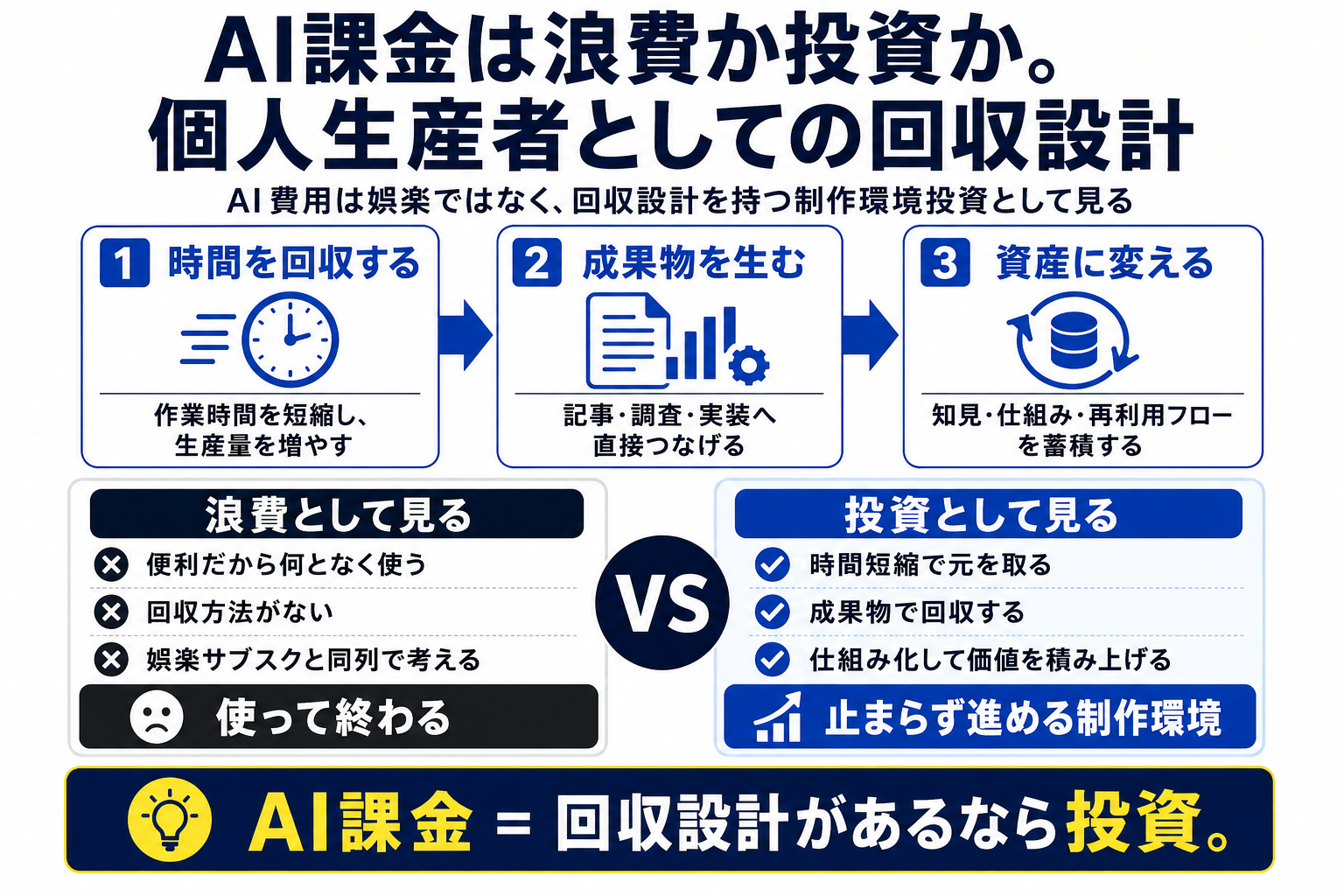
The value of AI spending is not decided by the fee itself. It is decided by what the fee turns into.
Treat AI fees as production infrastructure, not consumption
AI subscriptions can look like a visible fixed cost inside personal expenses. But when AI is used for writing, code, research, learning, design, and implementation, it differs from entertainment subscriptions. It is an environment cost for maintaining and extending productive capacity.
For an individual producer, the value of being able to keep making things without stopping is large. Hitting limits, switching models, and re-explaining context to another service can cost more than the monthly fee itself.
Judge only by the fee
- Measure only time savings
- Ignore recovery design
- Treat it as a tool expense
Judge as production infrastructure
- Keep work moving
- Leave judgment criteria behind
- Reuse outputs as assets
The explanation cost of using multiple AIs is also spending
Using several AI services can look optimized by specialty. But context has to move every time. Rules must be maintained in multiple places, assumptions must be repeated, and output differences must be absorbed. These invisible tasks accumulate as time cost.
Even if the monthly fee is lower, spending several hours every week on explanation and rechecking can make the setup more expensive in practice. A single environment that supports consultation, implementation, research, and article creation may recover its cost even at a higher price.
Recovery starts with time and assets, even before revenue
If AI ROI is judged only by immediate revenue, the evaluation becomes too narrow. Creating fifteen article candidates quickly, reducing research time, improving Codex request templates, and growing an insight database are all assets even before they become cash.
Invest by production phase, not by always choosing the top plan
The highest plan is not always necessary. During light consultation or ordinary daily use, a normal plan may be enough. During concentrated article production, major site work, or heavy Codex usage, however, stopping because of limits can itself become the loss.
The practical question is what phase you are in: accumulation, implementation, research, or publishing. The model, capacity, and tool level should change with that phase.
Separate weak use from strong use
The difference is not whether you pay for AI. The difference is whether that payment is converted into production speed, reusable knowledge, and lower friction.
Weak use
- Choose only by cheapness
- Measure only short-term speed
- Leave overlapping roles unmanaged
Strong use
- Treat it as production infrastructure
- Use it with recovery design
- Reduce role overlap and explanation cost
AI spending becomes investment when it is converted into outcomes
Look not at the monthly fee itself, but at whether it becomes saved time, production volume, judgment criteria, and intellectual assets. If the result makes the next work lighter, AI spending is not merely a convenience-tool fee. It is recoverable production infrastructure.
- AI spending should be treated as production infrastructure, not a convenience-tool fee
- The ROI of AI use can be explained significantly through saved time
- A normal plan may be enough in ordinary months, while concentrated production months make stronger plans more rational