Build a Judgment OS, Not a Memo Pile.
Why an Insight Database Becomes a Personal Asset in the AI Era
An insight database is not just a place to store passing thoughts. What belongs there is the context for what to choose next, what to avoid, and which standards to use. By turning stored information into reusable judgment, it becomes a personal asset in the AI era.
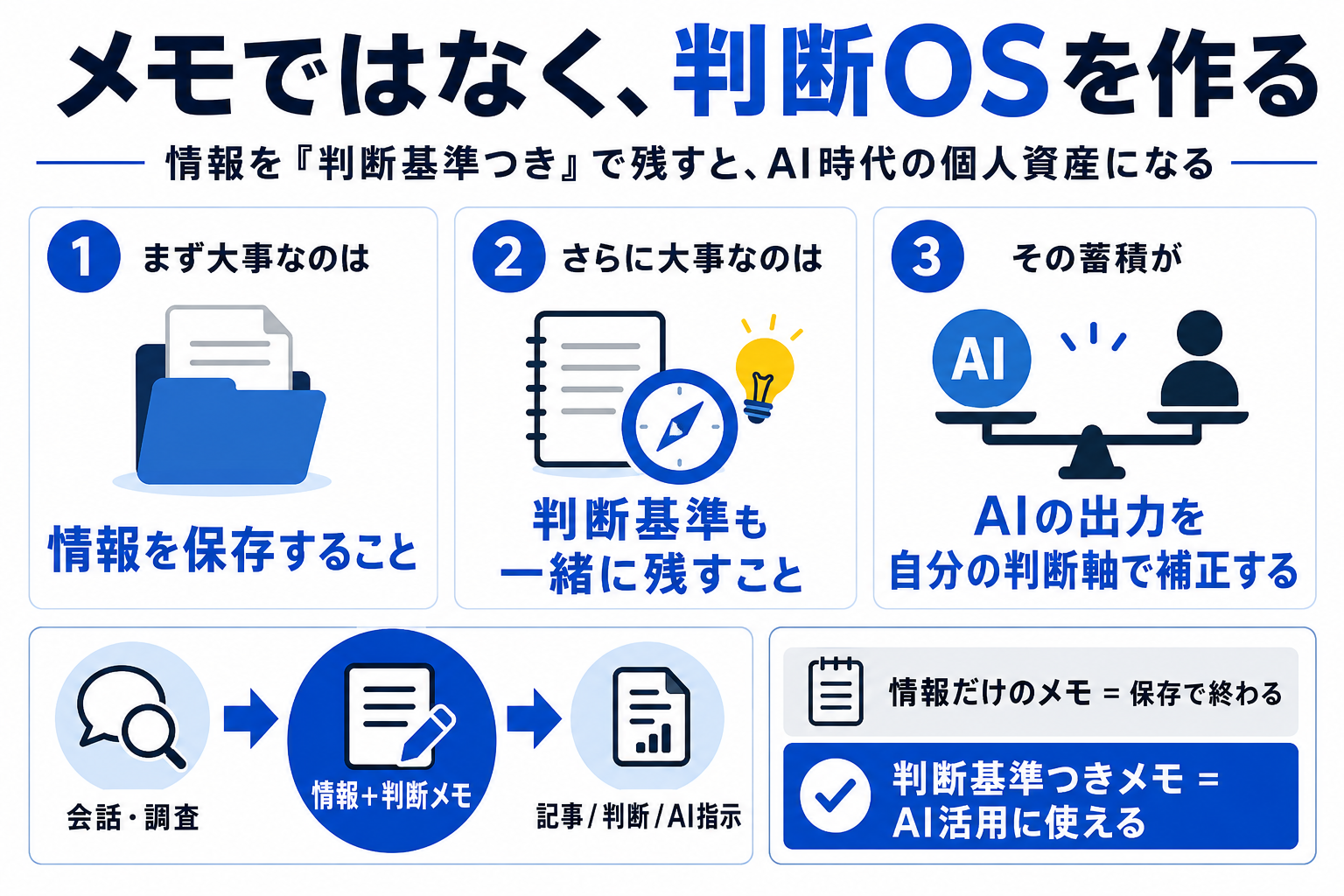
What should be saved is not information, but criteria that make the next judgment faster
People want to save information: articles, links, conversation logs, research results, and ideas. They have value, but if only information increases, it becomes impossible to find later, hard to use, and eventually ends as 'saved and forgotten.'
What an insight database should really store is not the information itself, but judgment criteria. Why is this article useful? What can this idea be reused for? In which situations should it not be used? When that context remains, the next decision becomes faster.
This difference becomes large in the AI era. AI can handle huge amounts of information, but it does not naturally know an individual's past judgments. That is why it matters to database how you thought, what you valued, and where you felt discomfort.
Save information
- Save articles
- Collect links
- Let them get buried
Save judgment
- Keep the reason it is useful
- Turn it into criteria
- Make it passable to AI
The value of an insight database is not preserving the past. It is making future judgment faster.
An insight database is not a book of answers; it is a warehouse of judgment candidates
The content inside an insight database does not need to be a finished answer. What matters more is leaving discomfort and hypotheses that appear in the middle of judgment. Why did this bother me? Where might it be useful? What could it connect to? These unfinished thoughts become strong material later.
If only polished knowledge can be saved, the input threshold rises. If insights, judgment criteria, possible reuse, and cautions are stored instead, even rough thinking can be processed later. Given to AI, similar insights can be bundled into article candidates or operating rules.
The role of the database is not to save polished prose. It is to keep material that can restart thinking later. It is stronger as a place for collecting seeds of judgment than as a fixed answer collection.
- Fix the conclusion
- Treat past judgment as absolute
- Delete what is unnecessary
- Keep it as a judgment candidate
- Revisit when context changes
- Use it as instruction material
Rather than transplanting personality into AI, align the initial position of judgment
When you want AI to answer in a way that feels like you, tone instructions alone have limits. What is truly needed is material showing how you have judged in the past: what you considered good, what you avoided, which constraints mattered, and which expressions you disliked. When this is known, AI answers move from general advice toward your own context.
An insight database becomes reference context for that. AI does not need to memorize everything. In the right situation, related insights and judgment criteria can be passed in. Then AI can answer not only from the current question, but also from past judgment.
This is less personality reproduction and more alignment of the initial judgment position. Instead of explaining everything from zero each time, accumulated context lets AI start closer to where you already stand.
Do not perfect classification from the start; grow it while using it
A common failure in database operation is trying to create perfect classification from the beginning. If categories, tags, importance, and reuse destinations are too detailed, input becomes burdensome and continuity breaks.
It is fine to start rough. Title, content, judgment criteria, conclusion, and reuse destination are already valuable. When article creation begins later, AI can classify the material. Actual use will reveal which fields are necessary and which are not.
A database is not a finished product. It is a foundation that grows through operation. What matters is not building a beautifully organized empty database, but continuing to pour thinking into it even if it is a little rough.
Separate weak use from strong use
An insight database should be reframed not as a memo storage area, but as a personal OS that turns judgment criteria, prohibitions, article ideas, and AI instructions into reusable assets.
Weak use
- Save only information
- Freeze conclusions
- Have no reuse destination
Strong use
- Keep judgment criteria
- Grow a candidate database
- Use it for AI instructions
An insight database is a blueprint for making future judgment faster
What should remain is not a record of events, but material for deciding how to judge when a similar situation returns. When discomfort, prohibitions, and judgment criteria accumulate, the context that can be handed to AI grows, and the initial output position moves closer to your own thinking.
- Accumulated judgment criteria are more valuable than simple notes
- An insight database becomes an article generation engine, not just an idea notebook
- What needs to be remembered is the core, not the entire conversation